May 2021

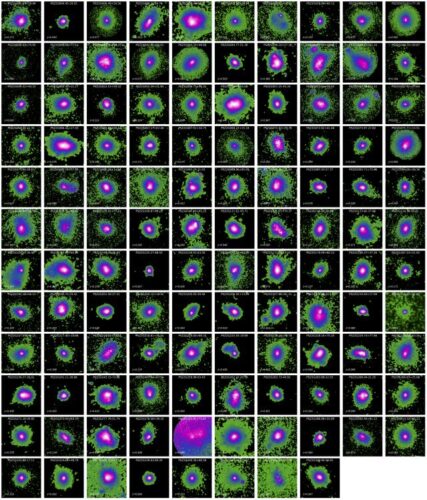
The 118 galaxy clusters of the CHEX-MATE program

An article published in the journal “Astronomy & Astrophysics” reports an overview of the CHEX-MATE (Cluster HEritage project with XMM-Newton – Mass Assembly and Thermodynamics at the Endpoint of structure formation) program’s work, which includes a study of a sample of 118 galaxy clusters carefully selected. The CHEX-MATE Collaboration observed those galaxy clusters with ESA’s XMM-Newton space telescope in a survey lasting a total of 3 million seconds.

A NASA diagram of the PWS instrument's location and the antenna in common with the PRA instrument

An article published in the journal “Nature Astronomy” reports a study on the faint interstellar plasma waves detected by NASA’s Voyager 1 space probe. A team of researchers led by Stella Koch Ocker of Cornell University used a series of detections conducted by Voyager 1 while traveling a total distance that is about ten times the average distance of the Earth from the Sun which gives an idea of ​​the characteristics of the interstellar plasma when it’s not altered by events related to solar activity.

The OSIRIS-REx space probe being prepared (Photo NASA/Dimitri Gerondidakis)

NASA has confirmed that its OSIRIS-REx space probe has left the asteroid Bennu after more than two years of study. In fact, OSIRIS-REx reached Bennu on December 3, 2018. In addition to the data collected with its instruments, OSIRIS-REx will bring back to Earth a capsule containing the Bennu samples collected on October 20, 2020. The return journey will be long because the arrival is scheduled for September 24, 2023.

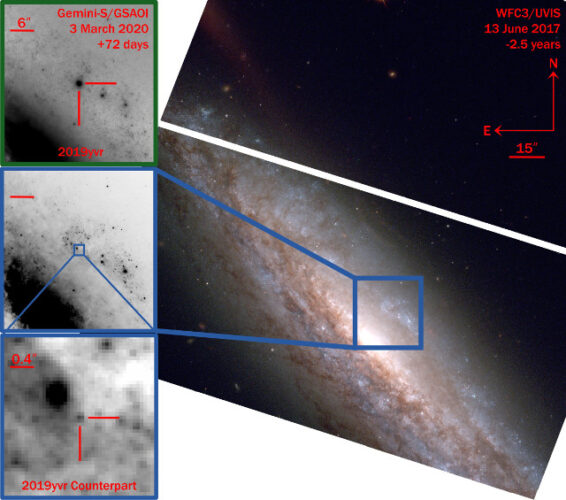
Views of the the supernova 2019yvr and the probable progenitor star

An article published in the journal “Monthly Notices of the Royal Astronomical Society” reports a study on the type Ib supernova cataloged as 2019yvr and on its progenitor star, which is enveloped by hydrogen layers that are unexpected in that type of supernova. A team of researchers led by Charles Kilpatrick, a postdoctoral fellow at Northwestern University, used observations made with the Hubble Space Telescope about 2.6 years before the supernova to examine the progenitor star, a yellow supergiant with characteristics very different from those they generally generate a type Ib supernova. One possibility regarding the hydrogen missing in the supernova is that it was snatched from this star by a companion.

Radio-infrared overlay of the W49A molecular cloud. (Image DePree, et al.; Sophia Dagnello, NRAO/AUI/NSF; Spitzer/NASA)

An article published in “The Astronomical Journal” reports the study of a nursery of stars in the great molecular cloud cataloged as W49A. A team of astronomers led by Professor Christopher De Pree of Agnes Scott College compared new observations conducted with the VLA (Very Large Array) at infrareds and radio waves of ​​W49A’s central area with observations conducted with the same radio telescope between 1994 and 1995. The result is the identification of new activities with supersonic gas movements in three regions and a high-speed jet in one region.