
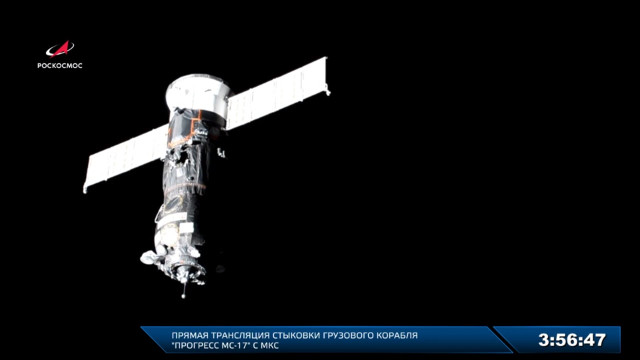
A few hours ago, the Progress MS-17 spacecraft docked with the International Space Station in the mission also referred to as Progress 78 or 778. The Russian cargo spacecraft, which blasted off last Tuesday, June 30, carries food, water, scientific experiments, fuel, and various hardware.
The Progress MS-17 cargo spacecraft docked with the International Space Station’s Russian Poisk module. Today, the crew will probably proceed with the hatch opening and the procedures to make the Progress MS-17 an appendage to the Station.
The first mission of the Progress MS-17 spacecraft is accomplished. In fact, it can’t return to Earth, so it will be filled with pieces of hardware that are faulty or have become unusable for some reasons and assorted garbage, and will disintegrate coming back to the Earth’s atmosphere. However, before this epilogue, it will be involved in the expansion of the International Space Station’s Russian section, hoping that the new modules will finally be launched into orbit.
According to plans, at the end of October, the Progress MS-17 space freighter will be relocated to dock with the Nauka laboratory, the first new Russian module. The goal is to prepare its docking port for the arrival of the Prichal module, scheduled for November. The problem, as usual, is given by the continuous delays in the launches of the modules.
As for the Nauka laboratory, the Russian space agency Roscosmos had already announced the launch for July 15 but in recent days the communication of a change of plans arrived. After years of delays, waiting a few more days will make no difference, as at this point the important thing is that they launch Nauka.
The arrival of the Nauka space laboratory will also affect the mission of the previous Russian space freighter, the Progress MS-16. That’s because it’s supposed to leave the International Space Station along with the Pirs module so that both are destroyed re-entering the Earth’s atmosphere. At this point, it remains to be seen whether Roscosmos will be able to continue with this plan or other problems will cause delays that will force the Russian space agency to modify it.
