
An article published in the journal “Nature Astronomy” reports a study on the star cluster Palomar 5 that indicates that in a billion years only black holes will remain inside it. A team of researchers led by Professor Mark Gieles of the University of Barcelona studied this ancient and very low-density cluster by conducting a series of simulations to try to predict its future. The number of black holes inside it is already above average today and is subject to gravitational interactions with the consequence that in the distant future its size will increase and only black holes will remain.
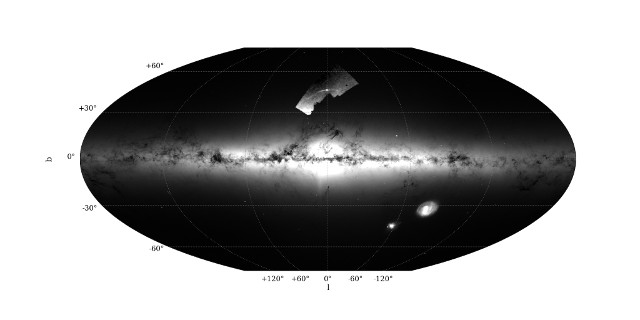
About 80,000 light-years from Earth, the Palomar 5 star cluster was discovered in 1950 and is one of the globular clusters that orbit the Milky Way. The image (Courtesy M. Gieles et al./Gaia eDR3 / DESI DECaLS. All rights reserved) shows a view of the sky with Palomar 5 at the top-center.
The age of the globular cluster Palomar 5 is estimated to be over 10 billion years, a remarkable age that is normal for these clusters but this is the only thing common for Palomar 5. Compared to the average characteristics for globular clusters, this one has about a tenth of the mass scattered in a volume that is five times higher instead. It’s disintegrating and the team led by Professor Mark Gieles tried to understand the processes in place to see what future awaits Palomar 5.
The research on the Palomar 5 globular cluster starts from current data, which see the number of black holes three times greater than what would be expected from the number of stars present. This means that now over 20% of the mass of Palomar 5 is made up of black holes, each of which has a mass that is about 20 times the Sun’s. These are remarkable masses for black holes originating from dead stars and probably there are were mergers of black holes.
The interactions that are causing the disintegration of the globular cluster Palomar 5 are at the center of astronomers’ attention. The stars are coming out of the cluster generating what are called tidal streams, trails formed by those stars. It’s one of the many cases of tidal stream discovered in recent years in the Milky Way’s halo and there are still no certain explanations. Palomar 5 is the first steam associated with a star cluster.
Simulations indicate that streams are part of processes lasting billions of years in which stars get out of a star cluster more and more efficiently. Black holes generate gravitational slingshot effects that favor the stars “runaway”. This confirms some hypotheses regarding the mechanisms of origin of tidal streams.
According to the researchers, the processes taking place in the globular cluster Palomar 5 will lead to leaving only black holes within a billion years. The study of these clusters’ evolution processes also offers interesting research possibilities in the coming years. For example, the mergers between black holes that could take place within it could be detected thanks to their gravitational wave emissions, a rapidly growing branch of astronomy.
