An article published in the journal “Nature Astronomy” reports observations of the jets emitted by the supermassive black hole at the center of the radio galaxy Centaurus A with details never seen before thanks to the combination of different radio telescopes. A team of researchers including the Event Horizon Telescope (EHT) collaboration used the same technique that made it possible to obtain the historical image of the area around the supermassive black hole at the center of the galaxy M87. The Centaurus A observations took place in 2017 and now the results arrived, especially the details of the jets.
About 11 million light-years from Earth, Centaurus A is the closest radio galaxy to the Milky Way. The supermassive black hole at its center has a mass estimated to be around 55 million times the Sun’s. It’s one of the first radio sources identified outside the Milky Way in 1949. Also due to its strong radio emissions, it was the object of study by some generations of astronomers in all bands of the electromagnetic spectrum.
The supermassive black hole at the center of the Centaurus A radio galaxy is surrounded by gas and dust. Most of those materials get swallowed but some are ejected from the poles in two jets at speeds close to the speed of light. These jets are also being studied to try to understand the details of the processes taking place in those extreme environments. For this reason, Centaurus A was among the targets of observations in the 2017 campaign of the Event Horizon Telescope collaboration, which combines observations conducted using different radio telescopes.
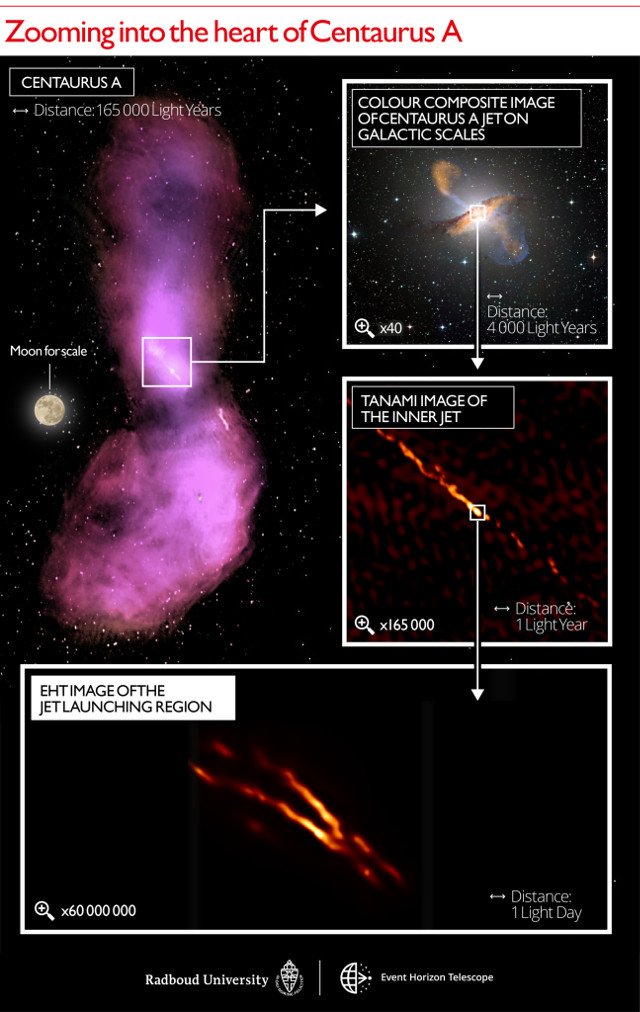
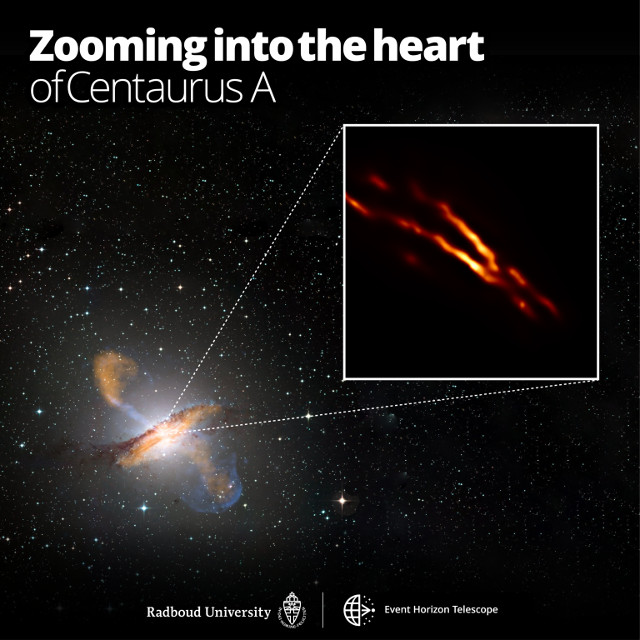
The top image (Radboud University; ESO/WFI; MPIfR/ESO/APEX/A. Weiss et al.; NASA/CXC/CfA/R. Kraft et al.; EHT/M. Janssen et al.) shows Centaurus A at high resolution in the inset superimposed on an image of the galaxy hosting the supermassive black hole. The bottom image (Radboud University; CSIRO/ATNF/I.Feain et al., R.Morganti et al., N.Junkes et al.; ESO/WFI; MPIfR/ESO/APEX/A. Weiss et al.; NASA/CXC/CfA/R. Kraft et al.; TANAMI/C. Mueller et al.; EHT/M. Janssen et al.) shows Centaurus A at different scales. The top left image shows how the jet disperses into gas clouds that emit radio waves. In the following images, there’s a progressive zoom up to the detail of the get in the lower panel.
The image of one of the jets ejected from a supermassive black hole at the center of Centaurus A confirms that it’s brighter at the edges than at the center but thanks to the details of this image this phenomenon was never seen so pronouncedly before. These are useful details to better understand how these jets are formed and to improve the current models, which are far from complete. For example, it’s not clear how the jets are launched from the vicinity of the supermassive black hole and how they extend for light-years without dispersing.
The images obtained thanks to the EHT represent a new phase of research on supermassive black holes and on the processes taking place in these truly extreme environments. Thanks to the details of the jet, it was possible to infer the likely position of Centaurus A’s supermassive black hole, a useful result to conduct follow-up observations. There are various ideas for future studies, some of which will require new generation instruments.