
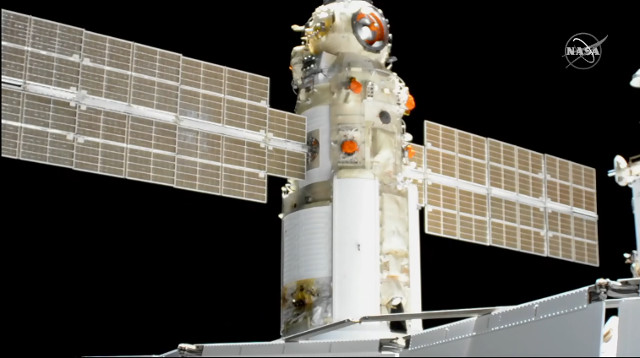
A little while ago, the Russian Nauka module, formally called the Multipurpose Laboratory Module (MLM), docked with the International Space Station, becoming part of the Russian section many years late. Along with it is the European Robotic Arm (ERA) developed under the auspices of ESA. Nauka/MLM replaces the Pirs module, which on July 26 was dropped from the Station and transported by the Progress MS-16 cargo spacecraft to Earth’s atmosphere, where both disintegrated on reentry. Nauka was launched on July 21.
The Pirs module was supposed to be temporary, originally designed to be part of the Mir-2 space station, a Russian project abandoned after the decision to be part of the International Space Station project. Eventually, it remained in orbit for nearly twenty years witnessing the difficulties of the Russian space agency Roscosmos in preparing the Nauka/MLM module.
The flight of the Nauka/MLM module was also complicated and turned into a kind of space mystery. In its pursuit of the International Space Station, several maneuvers were needed but soon the rumors of problems with the main thrusters began. Difficulties in communicating telemetry data made it hard to understand the exact nature of the problems, not least because other sources denied them. Over the past few days, Roscosmos communicated the various maneuvers conducted by Nauka, included the ones with its main thrusters. The latest mystery concerned the risk that the thrusters’ situation would leave only one docking chance with the Zvezda module.
As its formal designation says, the Nauka module was built for various purposes. It’s a laboratory designed to conduct scientific experiments becoming the primary Russian research center on the Station and as a living area for cosmonauts. For the moment, it will replace the Pirs module for docking Russian cargo spacecraft and Russian Soyuz spacecraft carrying crew members. However, this task will later be carried out by the Prichal module, which according to plans will be launched in November 2021.
The arrival also had some thrilling moments. The Kurs automatic docking system seemed to fail to get the correct attitude but eventually, the docking with the Zvezda module was successful. Cosmonauts Oleg Novitskiy and Pyotr Dubrov began the procedures to make Nauka/MLM a part of the International Space Station and should try to open the new module’s hatch within the day. The tasks to bring Nauka/MLM to full operation will take months but its arrival was the difficult part.
