October 2021

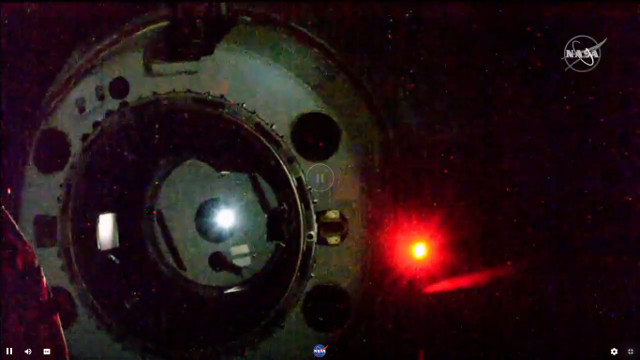
The Soyuz MS-19 spacecraft approaching the International Space Station (Image NASA TV)

A few hours ago the Soyuz MS-19 spacecraft was launched from the Baikonur Cosmodrome in Kazakhstan and after a little more than three hours reached the International Space Station with three new crew members on board. The ultra-fast route was used which halves the journey duration. The docking with the Station’s Rassvet module was about 10 minutes late because the Kurs automatic system had some problems and cosmonaut Anton Shkaplerov had to manually pilot the Soyuz MS-19.

GW Orionis' protoplanetary dsk

An article published in the journal “Monthly Notices of the Royal Astronomical Society” reports a study on the triple system of GW Orionis, or simply GW Ori, which claims that there is at least one exoplanet, which would be the first known to orbit three stars. A team of researchers led by Jeremy Smallwood of the University of Nevada Las Vegas examined observations of the rings of GW Ori’s protoplanetary disk made with the ALMA radio telescope. The goal was to try to establish the cause of the presence of void within one of them and the conclusion is that one or more exoplanets have formed or are forming.

The Dragon cargo spacecraft departing the International Space Station to end its CRS-23 mission (Image NASA TV)

A few hours ago, the SpaceX Dragon spacecraft ended its CRS-23 (Cargo Resupply Service 23) mission for NASA splashing down smoothly in the Gulf of Mexico, off the coast of Florida. The Dragon left the International Space Station a few hours earlier. For SpaceX, this was the third mission of the second contract with NASA to transport resupplies to the Station with the new version of the Dragon cargo spacecraft, which splashes down near the East coast of the USA instead of the Pacific Ocean.