
2021

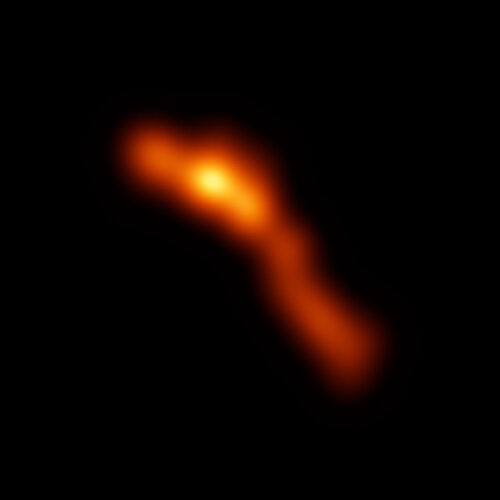
The jet from protostar Cep A HW2 seen by the VLA (Image Carrasco-Gonzalez et al., Bill Saxton, NRAO/AUI/NSF)

An article accepted for publication in the “Astrophysical Journal Letters” reports a study on the massive protostar Cep A HW2 and in particular on the jets of materials ejected from it. A team of researchers used the VLA to capture the best images so far of a protostar that, at the end of its formation, will likely be about 10 times more massive than the Sun. The details of the ejected jets indicate that they have an origin close to the star that has a wide angle and then tapers as the distance increases, a process called collimation. In lower-mass protostars, the collimation of the jets occurs much closer to their surface. Understanding the reason for this difference will help to better understand star formation processes.

SpaceX's Dragon 2 cargo spacecraft blasting off atop a Falcon 9 rocket (Photo NASA/Kim Shiflett)

A few hours ago the SpaceX Dragon 2 spacecraft blasted off atop a Falcon 9 rocket from Cape Canaveral in its CRS-22 (Cargo Resupply Service 22) mission, also referred to as SPX-22. After almost exactly 12 minutes it separated successfully from the rocket’s last stage and went en route. This is the 22nd mission for the Dragon spacecraft to resupply the International Space Station with various cargoes and then return to Earth, again with various cargoes. It’s the second mission for this Dragon version.

The galaxy NGC 2276 (Image ESA/Hubble & NASA, P. Sell. Acknowledgement: L. Shatz)

An image captured by the Hubble Space Telescope shows the galaxy NGC 2276. It’s a spiral galaxy that shows some peculiarities, as its shape is a bit distorted and the colors that indicate the distribution of the stars inside it reveal a certain irregularity. The reason for that is the interaction with a neighbor, the galaxy NGC 2300, whose force of gravity distorted some of NGC 2276’s spiral arms. Another interaction also involves the intergalactic gas that is present in the cluster that includes these two galaxies, which crashed into NGC 2276 triggering a high rate of star formation on an outer side of this galaxy.

Structures at the center of the Milky Way seen by Chandra and MeerKAT

An article published in the journal “Monthly Notices of the Royal Astronomical Society” reports a study of the center of the Milky Way that reveals the presence of superheated gas threads and magnetic fields. Astronomer Q. Daniel Wang of the University of Massachusetts at Amherst combined the results of 370 observations of various parts of that area conducted with NASA’s Chandra X-ray Observatory adding observations conducted using the MeerKAT radio telescope. The results suggest the possibility of ongoing processes that could be due to an unknown energy source in the galactic center.