2021

The double quasars cataloged as J0749+2255 and J0841+4825

An article published in the journal “Nature Astronomy” reports the discovery of two double quasars that could be part of a hidden population because two quasars that are very close are difficult to distinguish. A team of researchers used Hubble Space Telescope observations of quasars to find these pairs dating back to about 10 billion years ago. The two quasars of each pair are about 10,000 light-years apart, and the galaxies that host them will merge and at a certain point the supermassive black holes that power the quasars will merge as well.

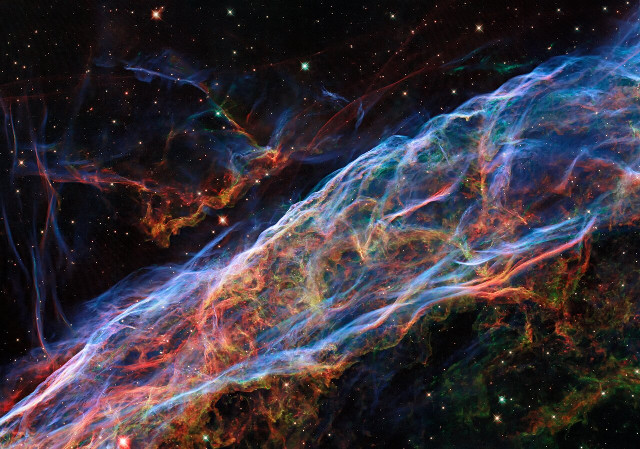
A part of the Veil Nebula (Image ESA/Hubble & NASA, Z. Levay)

A photo of part of the Veil Nebula captured by the Hubble Space Telescope offers a new view of these supernova remnants after applying new processing techniques. The Veil Nebula has already been at the center of observations, analysis, and processing of the images obtained because those remnants form a vast diffuse nebula that is made up of different parts cataloged with different designations and known by different names. This nebula in turn is only the visible part of the Cygnus Loop, as these supernova remnants must be observed in a wider range of the electromagnetic spectrum to be fully detected.

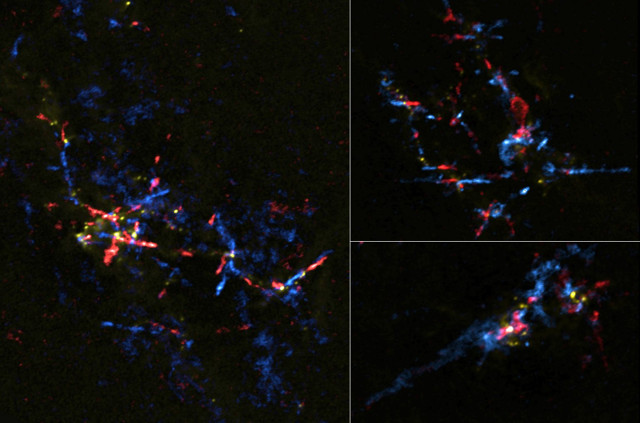
Some outflows indicating an origin from protostars

An article published in “The Astrophysical Journal” reports the discovery of four massive molecular clouds in the central area of ​​the Milky Way with traces of star formation in an area that was considered too chaotic for that to happen. A team of researchers used the ALMA radio telescope to examine the so-called Milky Way’s Central Molecular Zone (CMZ), discovering over 800 of what are considered stellar eggs, meaning dense cores of gas and dust. ALMA made it possible to detect 43 energetic outflows of materials with characteristics associated with star formation, further evidence of what’s happening in that area.

Starship SN11 blasting off in the fog (Image courtesy SpaceX)

It was yesterday morning in Boca Chica, Texas, when SpaceX conducted the flight test of the Starship prototype identified as SN11, the fourth after that of March 3, 2020. There was fog in the area, and many people thought that the test would have been postponed, instead SN11 was launched. The consequence is that practically nothing could be seen and only the cameras installed on the prototype showed something, even if it was information concerning the activity of the three Raptor engines. Something happened during the descent maneuvers, the images froze, and from the commentary on the live view, the viewers discovered that SN11 exploded for reasons yet to be verified. It seems like a step backward for SpaceX, but Elon Musk’s company continues with the tests, and the plan is to fly SN15, skipping three prototypes. There’s also progress for the SuperHeavy rocket.

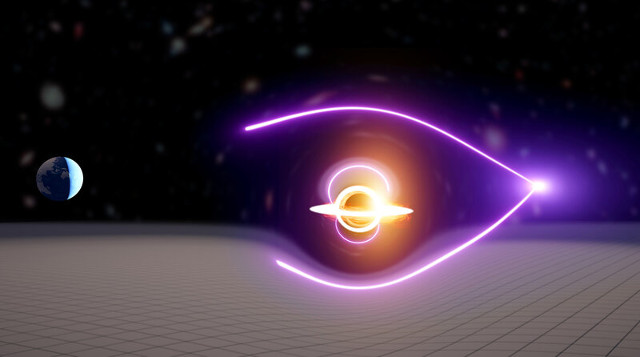
Artistic concept of the candidate intermediate-mass black hole and its deflected gamma-ray burst (Image courtesy Carl Knox, OzGrav)

An article published in the journal “Nature Astronomy” reports the discovery of a candidate intermediate-mass black hole. A team of researchers studied a gravitational lens using detections of photons that were part of a gamma-ray burst to calculate the mass of the lens based on the delay caused by the deviation of the photons of its “echo”. The result is that the mass of the object acting as a gravitational lens was estimated to be about 55,000 times the Sun’s. The nature of the object is not certain but the analysis of the data clearly favors the hypothesis that it’s an intermediate-mass black hole, a type of black hole that is rare and, above all, very elusive.