2021

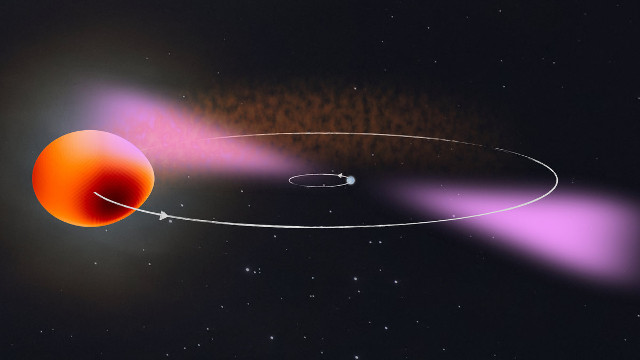
Artist's concet of the pulsar PSR J2039-5617 and its companion (Image Knispel/Clark/Max Planck Institute for Gravitational Physics/NASA GSFC)

Two articles published in the journal “Monthly Notices of the Royal Astronomical Society” report different aspects of the study that led to the identification of the rare characteristics of a gamma-ray source that turned out to be a pulsar, cataloged as PSR J2039-5617. Two teams with various researchers in common used data collected by the Fermi Space Telescope and other instruments, and relied on the help of citizen scientists participating in the Einstein@Home project to study the pulsar. It’s a rare type of pulsar because it belongs to the millisecond class and also to the so-called redback class, which has a red dwarf as a companion.

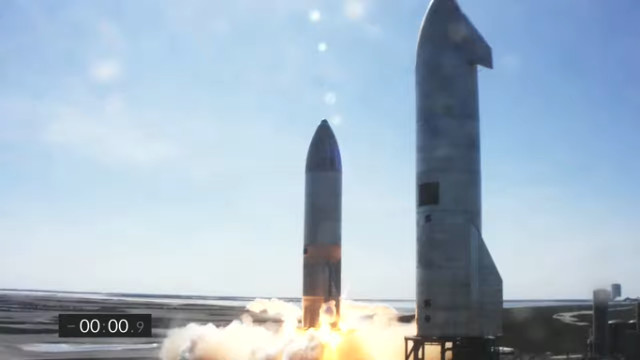
Starship SN9 blasting off (Image courtesy SpaceX)

It was afternoon in the USA when SpaceX conducted in Boca Chica, Texas, the flight test of the Starship prototype identified as SN9, the second after the one conducted on December 9, 2020. SN9 was supposed to solve the problems of the previous prototype and it too carried out regularly its flight up to an altitude of about 10 kilometers and then attempted a controlled landing at the end of a series of maneuvers. After 6 minutes and 26 seconds of flight, like its predecessor, SN9 landed too fast and was destroyed as a result. SpaceX confirmed that its good results with regards to Starship’s maneuverability, but landing is still an issue. With the many first-stage landings of the Falcon 9 rocket, it’s making that kind of maneuver look easy, but it requires perfect systems tuning.

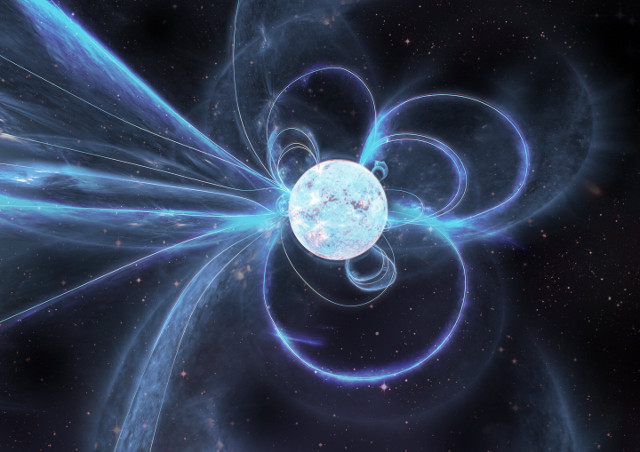
Artist's concept of Swift J1818.0-1607 with its magnetic field (Image courtesy OzGrav, Carl Knox)

An article published in the journal “Monthly Notices of the Royal Astronomical Society” reports a study on the magnetar Swift J1818.0-1607 that describes its behavior, more complex than expected. A team of researchers led by Marcus Lower of Swinburne University of Technology in Australia observed it between May and October 2020 with the Parkes radio telescope noting that its emissions varied from that of a magnetar to that of a pulsar, alternating typical behaviors of these two types of neutron stars. It eventually settled into the magnetar state, and that can offer insights into the evolution of these strange objects.

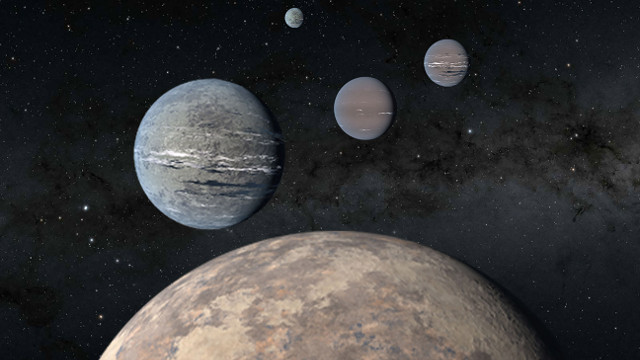
Artist's concept of the planets orbiting HD 108236 (Image NASA/JPL-Caltech)

An article published in “The Astronomical Journal” reports the confirmation of four exoplanets, one super-Earth and three mini-Neptunes, in the system of the star HD 108236. A team led by Tansu Daylan, postdoc Kavli Institute for Astrophysics and Space Research at MIT, analyzed data collected by NASA’s TESS space telescope to identify those exoplanets. Two high school students also participated in this research as part of the Student Research Mentoring Program (SRMP) at the Center for Astrophysics | Harvard & Smithsonian. An article accepted for publication in the journal “Astronomy & Astrophysics” reports the discovery of another super-Earth in the same system by a team of researchers led by Andrea Bonfanti of the Austrian Academy of Sciences that used ESA’s CHEOPS space telescope.

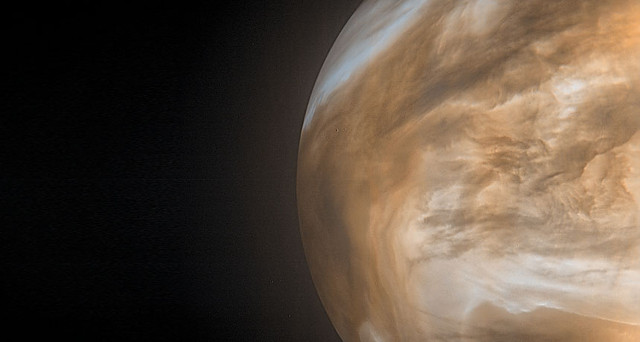
The night side of Venus seen by the Akatsuki space probe (Image courtesy JAXA / ISAS / DARTS / Damia Bouic)

An article accepted for publication in “The Astrophysical Journal” reports research that offers an alternative explanation to the presence of phosphine on Venus. A team of researchers used a robust model of the conditions in Venus’s atmosphere reanalyzing the data that led to the conclusion that there was phosphine. The new conclusion is that the data are consistent with the presence of sulfur dioxide.