2021

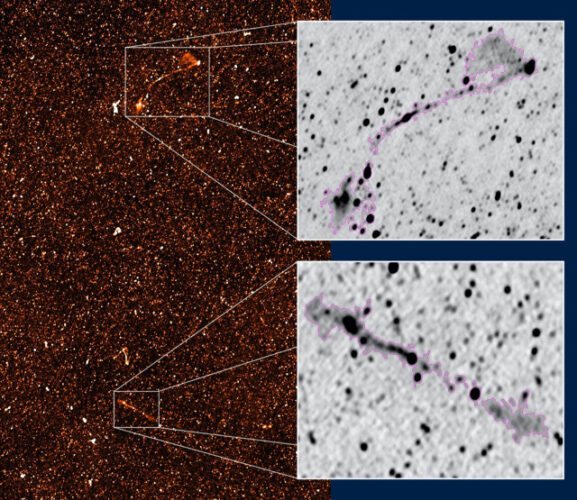
A portion of the radio map of the sky in the MIGHTEE survey with the two giant radio galaxies in the insets

An article published in the journal “Monthly Notices of the Royal Astronomical Society” reports the discovery of two giant radio galaxies in a small portion of the sky, a discovery in theory very unlikely. A team of researchers led by Jacinta Delhaize of the University of Cape Town, South Africa, used data collected during the MIGHTEE survey conducted with the MeerKAT radio telescope. Giant radio galaxies are considered very rare, but are perhaps much more common than expected, a possibility that could have an impact on studying the formation and evolution of galaxies.

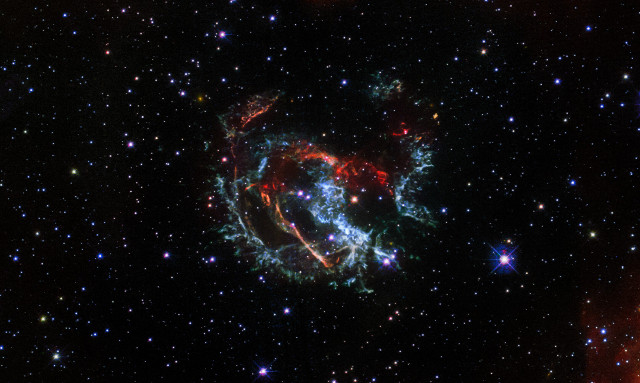
1E 0102.2-7219 (Image NASA, ESA, and J. Banovetz and D. Milisavljevic (Purdue University))

An article under review for publication reports a study on the supernova remnants cataloged as 1E 0102.2-7219 which estimate its place of origin and its age. A team of researchers led by John Banovetz and Danny Milisavljevic of Purdue University in West Lafayette, Indiana, USA, used observations conducted with the Hubble Space Telescope to reconstruct the history of that supernova that occurred in the Small Magellanic Cloud. The conclusion is that the light from the progenitor star’s explosion reached Earth about 1,700 years ago.

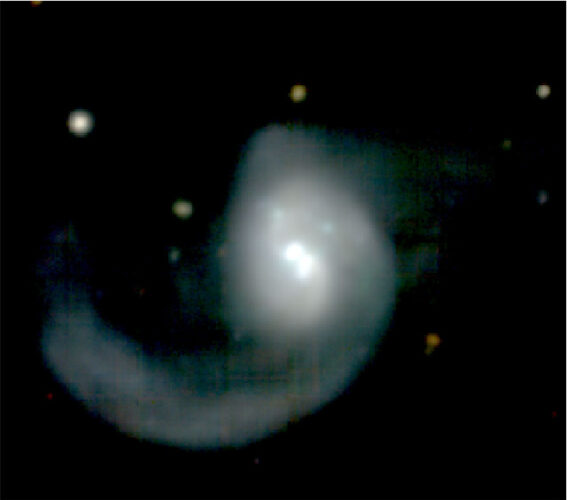
The galaxy ESO 253-G003 seen by the MUSE instrument (Michael Tucker (University of Hawai’i) and the AMUSING survey)

An article under review for publication reports a study on the galaxy ESO 253-G003 that classifies it among the ones with an active galactic nucleus that is consuming a star orbiting the central supermassive black hole. A team of researchers led by Anna Payne of the University of Hawaii used observations conducted with various telescopes to study the phenomenon, cataloged as ASASSN-14ko, detecting a series of regular cosmic outbursts that were interpreted as energy emissions linked to the passage of a star too close to the black hole, which destroys a part of it at each orbit.

The Dracon cargo spacecraft departing the International Space Station (Image NASA TV)

A few hours ago the SpaceX Dragon spacecraft ended its CRS-21 (Cargo Resupply Service 21) mission for NASA splashing down smoothly in Gulf of Mexico, off the coast of Florida. The Dragon left the International Space Station last Tuesday. For SpaceX, this was the first mission of the second contract with NASA to transport resupplies to the Station with the new version of the Dragon cargo spacecraft, the first to splash down near the East coast of the USA instead of the Pacific Ocean.

Artist's representation of the galaxy ID2299 (Image ESO/M. Kornmesser)

An article published in the journal “Nature Astronomy” reports a study on a massive galaxy in the distant universe in which a galaxy merger appears to have inhibited star formation. A team of researchers led by Annagrazia Puglisi of Durham University’s Center for Extragalaxy Astronomy used the ALMA radio telescope to examine the galaxy cataloged as ID2299 and found star formation activity in its central regions while a huge amount of gas was ejected removing the possibility of forming new stars.