
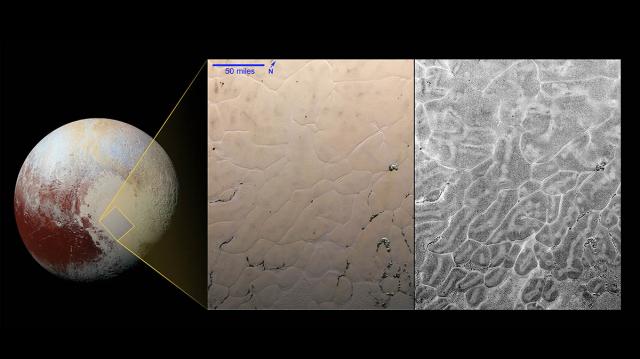
An article published in the “Journal of Geophysical Research: Planets” reports a study that once again addresses the question of the possibility that the dwarf planet Pluto has or at least had in the past an underground ocean. P. J. McGovern, O. L. White, and P. M. Schenk used data collected by NASA’s New Horizons space probe to analyze in particular the geological features of Sputnik Planitia, a vast basin that makes up the western part of Pluto’s heart-shaped region. The results are important to assess for example the thickness of its lithosphere and how this dwarf planet was formed.
The extraordinary Pluto flyby performed on July 14, 2015, by the New Horizons space probe made it possible to obtain a wealth of information unthinkable without the use of instruments close to this dwarf planet. The data is also useful in discussions regarding the possibility that Pluto has or had an underground ocean of liquid water. The idea might seem absurd considering its distance from the Sun and also from giant planets that can warm its subsoil as happens to moons such as Europa, Enceladus, and perhaps others. However, there are other hypotheses connected to Pluto’s formation.
Two opposing models describe the possible birth of an underground ocean of liquid water following the dwarf planet Pluto’s formation. According to the “cold” model, cold objects slowly coalesced over millions of years and eventually, enough radioactive materials may have generated enough heat to melt underground water ice. According to the “hot” model, violent collisions led to the formation of Pluto in a relatively short time, generating enough heat to warm its interior and form an ocean.
Some clues regarding Pluto’s formation come from the study of the Sputnik Planitia basin, the western part of the heart-shaped region, the most easily recognizable of the dwarf planet that became iconic after the publication of the photos taken by the New Horizons space probe. That basin was formed following an impact that generated a crater that was later filled with frozen nitrogen.
Scientists studying Pluto found Sputnik Planitia very interesting for the fractures on the ice surface. The image (NASA/JHUAPL/SwRI) shows Pluto and in the inset some details of that basin’s surface. Fractures offer information on the influence of frozen nitrogen on Pluto’s surface but it depends on that surface’s thickness. Nitrogen pushes down on the lithosphere, and its thickness affects how the surface fractures.
The authors of this study used computer models to simulate fractures in the surface of Sputnik Planitia to verify which geological conditions generated the ones observed by the New Horizons space probe. The result is that the lithosphere must have a thickness between 45 and 70 kilometers and that the crater that formed that basin had a limited initial depth, no more than 3 kilometers.
According to the researchers, the results are consistent with the “hot” model for Pluto’s formation. If these conclusions are correct, the heat generated by the impacts that formed the dwarf planet enabled the birth of an ocean of liquid water that froze over time. Another conclusion concerns the cryovolcanoes present around Sputnik Planitia, whose activity can be facilitated by the stress caused by the movements of the frozen nitrogen.
This is unlikely to be the last study regarding the possible presence of an underground ocean on Pluto. The amount of data collected by the New Horizons space probe continues to be studied and there are studies involving other objects, especially moons, to try to understand in what conditions there may be liquid water in their subsoil. They’re studies also linked to the conditions in which life forms could emerge that will be extended to exoplanets with advances in the observations of other planetary systems.
