September 2022

Mars seen on the left in a NASA image based on data from the Mars Orbiter Laser Altimeter (MOLA) and on the right by the Webb Space Telescope's Near-Infrared Camera instrument (NIRCam) at two different infrared wavelengths

The first images of Mars captured by the James Webb Space Telescope on September 5, 2022, offer views of the planet at different infrared wavelengths and some spectroscopies. Webb is in a position where it can see part of the sunlit side of Mars and can provide images and spectra to help complete the detections of space probes, rovers, and other telescopes. The red planet is very close and very bright compared to the normal targets of Webb’s observations, so the exposures used were very short to avoid causing problems to the instruments.

The "Wildcat Ridge" outcrop on Mars (Image NASA/JPL-Caltech/ASU/MSSS)

NASA’s Mars Rover Perseverance collected rock samples in an outcrop that was named “Wildcat Ridge” in the Jezero Crater on Mars. The analyzes show a geological variety that includes a mudstone that contains organic compounds. These results indicate that the rocks in that area are very different from those found on the crater floor, which were igneous rocks that form underground from volcanic magma and on the surface during volcanic activity. These are very interesting samples considering the mission in the design phase that will aim to bring them back to Earth to conduct in-depth analyzes.

The Orion Nebula's inner region seen by the James Webb Space Telescope (Image courtesy NASA, ESA, CSA, PDRs4All ERS Team; image processing Salomé Fuenmayor)

New images of the Orion Nebula’s inner region captured by the James Webb Space Telescope show new details of a stellar nursery that has already been studied many over time but continues to reveal new objects every time a new instrument is used to study it. These observations were conducted as part of Webb’s Early Release Science (ERS) program and obtained on September 11, so at the moment, no scientific articles are available on the subject yet but in the future, we can expect an analysis of the collected data and some new discoveries about the processes of star and planet formation.

The Sun as seen by the Solar Orbiter space probe on March 25, 2022

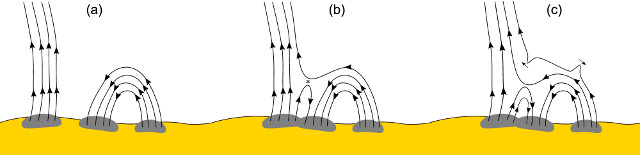
An article published in “The Astrophysical Journal Letters” offers a solution to the mystery of the local magnetic field inversion in the solar atmosphere, called switchback in jargon, observed in recent decades. A team of researchers with an important participation from the Italian National Institute of Astrophysics used detection conducted with the Solar Orbiter space probe’s METIS instrument to test the theories produced over the years.

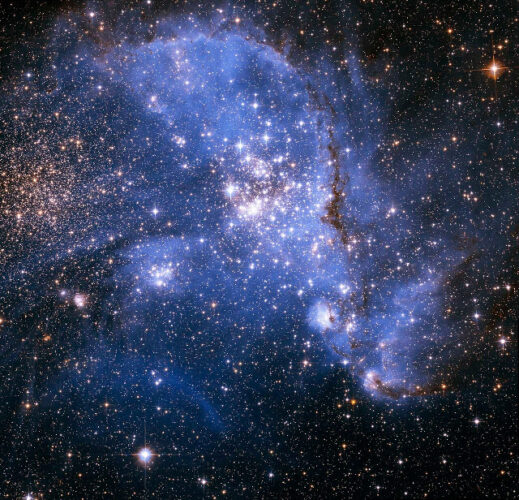
The cluster NGC 346 seen by Hubble (Image NASA, ESA, A. James (STScI))

Two articles published in “The Astrophysical Journal” report different aspects of a study on NGC 346, an open cluster of stars in the Small Magellanic Cloud, one of the satellite dwarf galaxies of the Milky Way. Two teams of researchers who share their respective leaders, Elena Sabbi of the Space Telescope Science Institute and Peter Zeidler of the AURA/STScI for ESA, used observations conducted with the Hubble Space Telescope and the VLT. They examined the spiraling motion of the cluster’s stars within it, a motion that appears to favor star formation.