
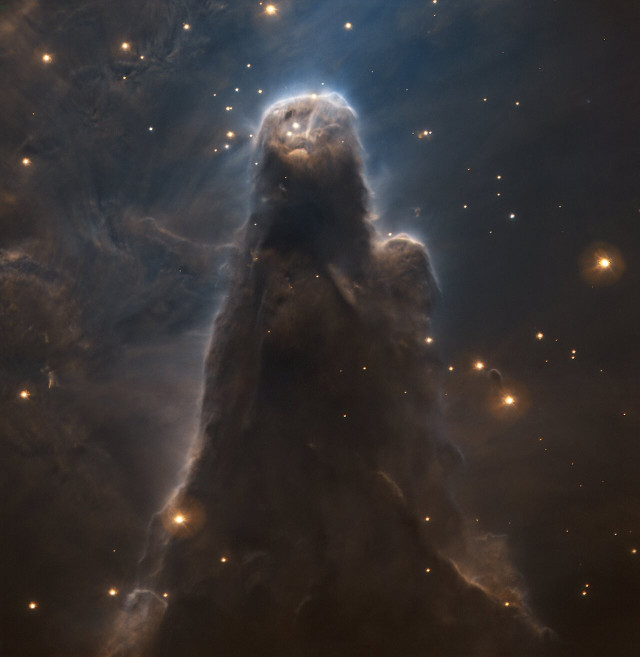
ESO has released an image of the Cone Nebula captured using the FOcal Reducer and low dispersion Spectrograph 2 (FORS2) instrument mounted on the Very Large Telescope (VLT) as part of the 60th-anniversary celebrations of this astronomical research organization’s creation. The convention to create the European Southern Observatory was signed on October 5, 1962, and led to the construction of state-of-the-art telescopes, also in collaboration with other organizations. 60 years of astronomy are also celebrated with a campaign of observations that among other things captured the image of the Cone Nebula.
Part of a larger region cataloged as NGC 2264 and nicknamed the Christmas Tree for its shape, the Cone Nebula is a star-forming region very interesting to astronomers. It is nearly 2,600 light-years away from Earth, practically in the neighborhood in astronomical terms, a boon for its observations. The pillar shape is the typical one that develops in the huge clouds of gas and dust in which stars are born. That’s because the young massive stars emit winds and powerful ultraviolet radiation that blows away the materials close to them while the more distant materials are compressed into that kind of shape.
The image captured by the FORS2 instrument mounted on the VLT shows in an extraordinary way the details of the Cone Nebula. The effect is of a dark, impenetrable nebula with a top that was compared to a mythological creature for its appearance. Hydrogen gas is shown in blue while sulfur gas is shown in red. The filters make massive young stars that are actually blue look almost golden.
ESO’s 60th-anniversary celebrations come with some delay due to a mystery linked to the La Silla Observatory in Chile. Professor Tom Marsh of the British Warwick University was one of the astronomers visiting La Silla but on September 16, two days after his arrival, his disappearance was reported. On November 10, it was announced that a body that is most likely his was found in the Atacama Desert, about 5 kilometers from the observatory.
Professor Tom Marsh’s sad fate doesn’t detract from ESO’s merits in the field of astronomy. The image of the Cone Nebula was chosen like many others used for outreach purposes on occasions not related to particular dates but within the program called Cosmic Gems. Various events have already been held on the occasion of the 60th anniversary of ESO’s creation and astronomical studies will continue in the future. In addition to the active observatories, the organization is building the Extremely Large Telescope (ELT) because ground-based telescopes have by no means been rendered obsolete by advances in space telescopes.
