November 2022

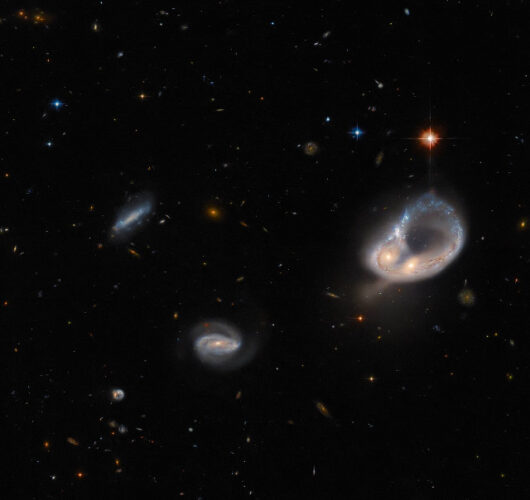
Arp-Madore 417-391, or simply AM 417-391, with other galaxies and stars

An image captured by the Hubble Space Telescope’s ACS instrument shows Arp-Madore 417-391, or simply AM 417-391, a pair of merging galaxies. It’s part of the Arp-Madore catalog, which collects particularly peculiar galaxies in the southern sky. It includes pairs of galaxies interacting at levels that go up to a merger just like AM 417-391.

The Advanced Camera for Surveys (ACS) instrument is optimized for hunting galaxies and galaxy clusters in the ancient universe. The AM 417-391 pair is “only” 670 million light-years away and makes an excellent object of study for astronomers interested in galaxy mergers.

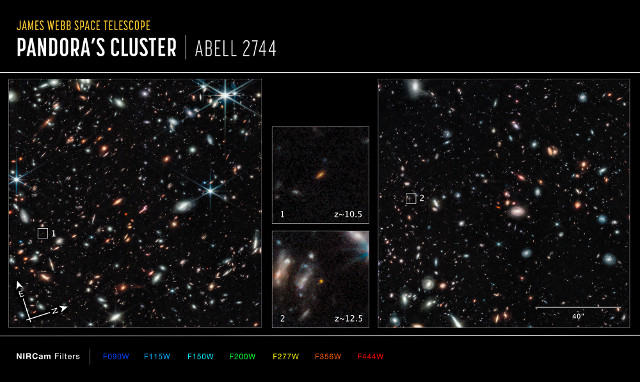
The galaxy cluster Abell 2744, nicknamed Pandora Cluster, with two boxes in the center showing the galaxies GLASS-z10 (1) and GLASS-z12 (2)

Two articles published in “The Astrophysical Journal Letters” report the results of the analysis of observations of the Abell 2744 galaxy cluster and the surrounding area with the James Webb Space Telescope. Two teams of researchers led respectively by Marco Castellano of the National Institute for Astrophysics in Rome, Italy, and by Rohan Naidu of the Harvard-Smithsonian Center for Astrophysics of MIT examined in particular two very distant galaxies. The galaxy called GLASS-z12 by the second team could be the oldest identified so far because according to estimates, it dates back to 350 million years after the Big Bang. The other galaxy, called GLASS-z10, is estimated to date back to 450 million years after the Big Bang.

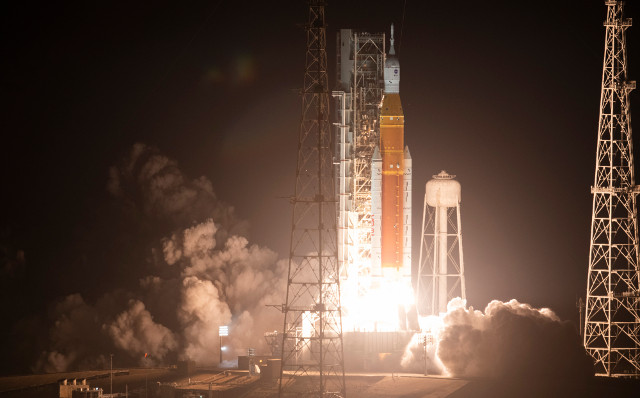
The Orion spacecraft blasting off atop the SLS to start the Artemis I mission (Photo NASA/Joel Kowsky)

A little while ago, NASA’s Orion spacecraft separated from the last stage, called the ICPS (Interim Cryogenic Propulsion Stage), of the Space Launch System (SLS), which blasted off almost two hours earlier from the Kennedy Space Center. The Orion entered the trajectory that will take it into the Moon’s orbit to carry out its mission which will last about 25 days. This is the first launch for the SLS and for the Orion in its full configuration. The ICPS also has the secondary mission of putting some CubeSat-class nanosatellites into orbit.

The star getting destroyed in the AT 2020neh event (Image NASA, ESA, Ryan Foley/UC Santa Cruz)

An article published in the journal “Nature Astronomy” reports a study of a so-called tidal disruption event, the destruction of a star by a black hole, in this case, an intermediate-mass black hole candidate. A team of researchers cataloged the event as AT 2020neh and studied it using the Hubble Space Telescope after its discovery, which happened thanks to the Young Supernova Experiment (YSE), a survey conducted using the Pan-STARRS telescopes. Intermediate-mass black holes are rare, at least as far as we know today, so each candidate discovered can offer new information, including on the possibility that they are precursors of supermassive black holes.

The Cone Nebula seen by the FORS2 instrument of VLT (Image ESO)

ESO has released an image of the Cone Nebula captured using the FOcal Reducer and low dispersion Spectrograph 2 (FORS2) instrument mounted on the Very Large Telescope (VLT) as part of the 60th-anniversary celebrations of this astronomical research organization’s creation. The convention to create the European Southern Observatory was signed on October 5, 1962, and led to the construction of state-of-the-art telescopes, also in collaboration with other organizations. 60 years of astronomy are also celebrated with a campaign of observations that among other things captured the image of the Cone Nebula.