2022

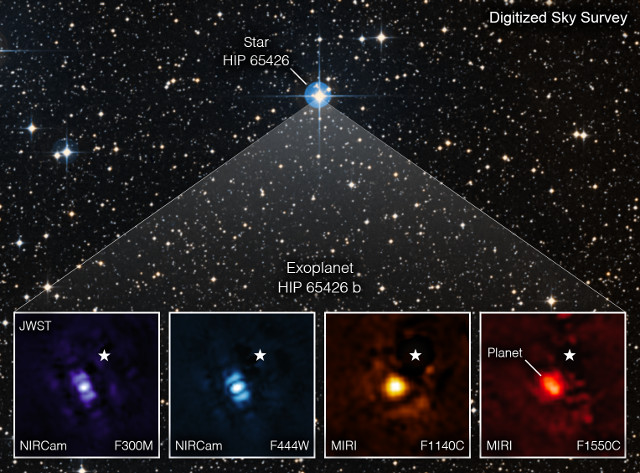
The star HIP 65426 in a Digitalized Sky Survey image and at the bottom, the exoplanet HIP 65426 b seen at different infrared frequencies by the James Webb space telescope's NIRCam and MIRI instruments

An article submitted for peer-review reports the results of the first direct observation of an exoplanet, a super-Jupiter cataloged as HIP 65426 b, by the James Webb Space Telescope. A large international collaboration led by Sasha Hinkley, associate professor of physics and astronomy at the British University of Exeter, conducted observations of this gas giant as part of Webb’s Early Release Science (ERS) program. There are no revolutionary results but the new space telescope observed new details of an already known exoplanet confirming that it can be a valuable instrument to study exoplanets.

Combined view of the galaxy SDSS J1448+1010 seen by ALMA and Hubble (Image ALMA (ESO/NAOJ/NRAO), J. Spilker et al (Texas A&M), S. Dagnello (NRAO/AUI/NSF))

An article published in “The Astrophysical Journal Letters” reports a study on the galaxy SDSS J1448+1010. A team of researchers used the ALMA radio telescope, the Hubble Space Telescope, and other instruments to examine it and found that no more stars are forming inside it. After analyzing the observations collected, they concluded that this is due to the fact that SDSS J1448+1010 is the result of a galaxy merger in which a large part of the hydrogen that forms the stars was ejected as a result of the gravitational effects suffered in the course of that event. In fact, the researchers discovered what was defined as a tidal tail formed by the ejected materials, which also include stars.

The galaxy M74 in a combined view at optical and infrared frequencies seen by the Hubble and Webb space telescopes, respectively

ESA has published images of the galaxy M74, nicknamed the Phantom Galaxy, captured by the Hubble and James Webb space telescopes with the addition of a combination between them. It’s a synergy that takes advantage of Hubble’s sensitivity to optical frequencies and Webb’s sensitivity to infrared frequencies. This allows to appreciate different details of a spiral galaxy that is practically visible face-on from the Earth and therefore an excellent object of study. Combining observations obtained with instruments that work in different electromagnetic bands is important Webb starts showing the great results it can offer in this type of study as well.

Artist's concept of the exoplanet TOI-1452 b (Image courtesy Benoit Gougeon, Université de Montréal)

An article published in “The Astronomical Journal” reports the discovery of a so-called ocean planet cataloged as TOI-1452 b. A team of researchers used observations conducted with NASA’s TESS space telescope and confirmation obtained using follow-up observations conducted with other instruments to locate and subsequently estimate the characteristics of this super-Earth that could be completely covered by an ocean. Its relative proximity to Earth and its position make it an excellent target for further observations, including with the James Webb Space Telescope.

The dwarf galaxy NGC 1156 seen by Hubble (Image ESA/Hubble & NASA, R. B. Tully, R. Jansen, R. Windhorst)

An image captured by the Hubble Space Telescope portrays the dwarf galaxy NGC 1156, a truly unique object because it’s an irregular dwarf galaxy that has various characteristics that belong to different classes of galaxies. Typically, galaxies that are out of the ordinary are the result of interactions or mergers, which are sometimes still in progress and offer the possibility to see the shapes of the original galaxies. NGC 1156 is among other things an isolated galaxy, and that means that there are no other galaxies close enough to affect its shape with a much higher force of gravity.