
2022

Pluto and Sputnik Planitia

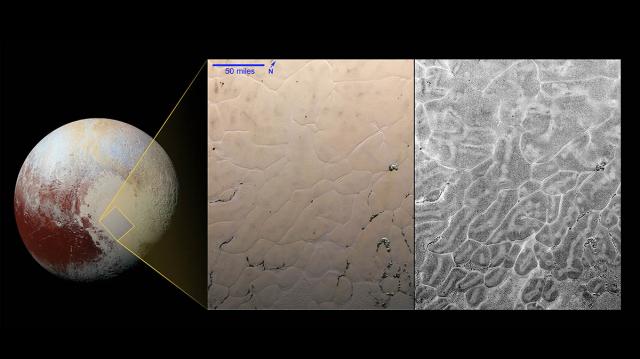
An article published in the “Journal of Geophysical Research: Planets” reports a study that once again addresses the question of the possibility that the dwarf planet Pluto has or at least had in the past an underground ocean. P. J. McGovern, O. L. White, and P. M. Schenk used data collected by NASA’s New Horizons space probe to analyze in particular the geological features of Sputnik Planitia, a vast basin that makes up the western part of Pluto’s heart-shaped region. The results are important to assess for example the thickness of its lithosphere and how this dwarf planet was formed.

The Milky Way center as seen by MeerKAT

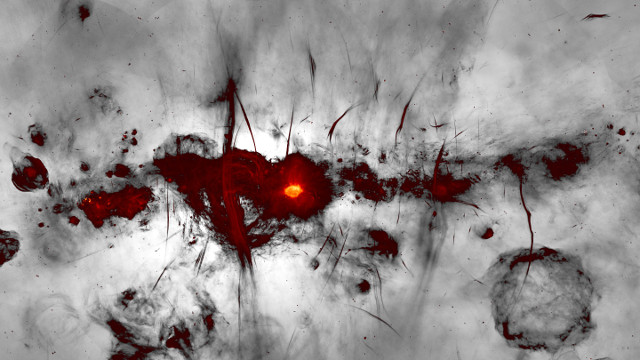
Two articles accepted for publication, one in “The Astrophysical Journal” and one in “The Astrophysical Journal Letters”, report different aspects of a study on the Milky Way’s center. A team of researchers used the MeerKAT radio telescope to examine the galactic center with a clarity and depth never obtained before. This made it possible to obtain new information on radio bubbles, supernova remnants, star nurseries, the region around the supermassive black hole at the center of the Milky Way, and many radio filaments.

Perspective view of Jovis Tholus

An image captured by ESA’s Mars Express space probe’s High Resolution Stereo Camera (HSRC) shows the Jovis Tholus shield volcano on Mars and the surrounding area with its geological features. The Tharsis region where Jovis Tholus is located includes some large volcanoes, first of all, Olympus Mons, the largest volcano in the solar system. Jovis Tholus’s interconnected calderas indicate a long period of volcanic activity and the more recent ones, each of which has a slightly lower floor, end up meeting even more recent lava flows. At 1,500 meters high and 58 kilometers in diameter, Jovis Tholus is much smaller than Olympus Mons yet provides a lot of information about the geology of the Tharsis region and its volcanic activity.

The Andromeda galaxy (M31) with the cluster B023-G078

An article published in “The Astrophysical Journal” reports the discovery of a rare intermediate-mass black hole in the Andromeda galaxy at the center of what could be a stripped nucleus, what remains of a galaxy swallowed by Andromeda. A team of researchers observed the star cluster cataloged as B023-G078 at the Gemini Observatory and with the Hubble Space Telescope to calculate the mass distribution within it, a crucial step to understand its nature as a stripped nucleus and identify the intermediate-mass black hole. This could be a way to discover this rare type of black hole, which some models claim merges with others to form supermassive black holes following galaxy mergers.

The Eta Carinae system

A new image portrays Eta Carinae bringing together observations in various bands of the electromagnetic spectrum from infrareds to X-rays thanks to the Hubble, Chandra, and Spitzer space telescopes. Each frequency offers some specific data on this pair of stars especially famous for the so-called Great Eruption that made it particularly bright for many years with a peak in 1843. The data put together also allowed to create 3D models of the Homunculus Nebula and gas and dust clouds surrounding the pair. This is useful research for astronomers to understand the evolution of Eta Carinae and also from an educational point of view within NASA’s Universe of Learning program.