
A special issue of “The Astrophysical Journal Letters” is focused on the gamma-ray burst cataloged as GRB221009A, indicated since the first estimates of its characteristics as the gamma-ray burst of the century. Various teams of researchers conducted various types of analyzes of the data collected by many instruments that detected the emissions from GRB221009A and the so-called afterglow, meaning from the residues of its emissions, in several electromagnetic bands. The wealth of data indicates that this is the most powerful gamma-ray burst ever observed and offers new insights into these extremely energetic phenomena. In this case, it was a long gamma-ray burst, probably generated by the collapse of the core of a massive star and the subsequent birth of a black hole.
According to a reconstruction that occurred long after the event, the gamma-ray burst GRB221009A was first detected by NASA’s Fermi Space Telescope, an instrument for detecting gamma rays. Many other instruments for detecting gamma rays and X-rays had problems measuring such powerful emissions. Earth’s atmosphere was also affected, as the upper ionosphere was strongly ionized in the struck area. All of this also made it difficult to locate the source of that event with initial estimates of its distance that were approximate and then converged on a galaxy about 2 billion light-years from Earth.
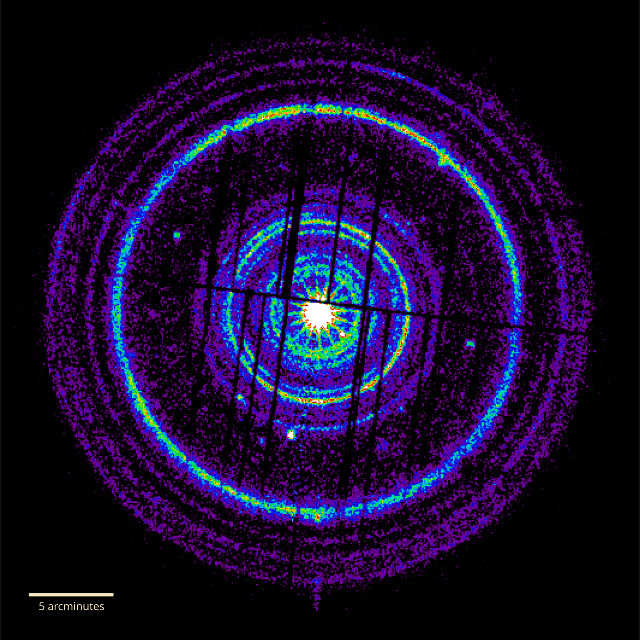
The observed X-ray emissions have among the reasons of interest the concentric rings, which correspond to the number of dust clouds encountered by the photons of the gamma-ray burst GRB221009A. The analysis of the captured X-ray images shows a total of 21 rings, another record for this event. Each ring offers information about the location of the matter encountered by the emissions, its chemical composition, and the size of the dust grains that make up the cloud.
According to the reconstructions, the gamma-ray burst GRB221009A was generated by the collapse of the core of a massive star that led to the birth of a black hole that emits jets of very high-energy particles in opposite directions as it gobbles up the materials that surround it. The jets are the ones that generated the afterglow.
A surprise came from analyzes of emissions at the other end of the electromagnetic spectrum. The Submillimeter Array (SMA) in Hawaii was among the radio telescopes that obtained the best observations of the gamma-ray burst GRB221009A’s afterglow. The millimeter wave and radio wave emissions were found to be much brighter than expected and may have been produced by a mechanism different from the ones discovered in the past in which one part of the jets produces visible light and X-ray emissions while another part produces millimeter and radio waves.
Astronomers also expected to detect a supernova and subsequently its remnants, which normally start expanding. So far they had no luck even with the James Webb Space Telescope, which has “only” detected infrared emissions from the afterglow. It’s possible that dust clouds blocked the supernova’s emissions and the star was so massive that the newborn black hole already had enough mass to gobble up the materials around it.
According to one estimate, a gamma-ray burst such as GRB221009A occurs once every 10,000 years. The power and quick alert widespread in the world of astronomy made it possible to obtain data from many different instruments, sometimes even by accident since even the Voyager 1 space probe, in interstellar space, detected some emissions. It’s an event of such importance that probably the studies published in the special issue of “The Astrophysical Journal Letters” are only the beginning of its analyses.
