
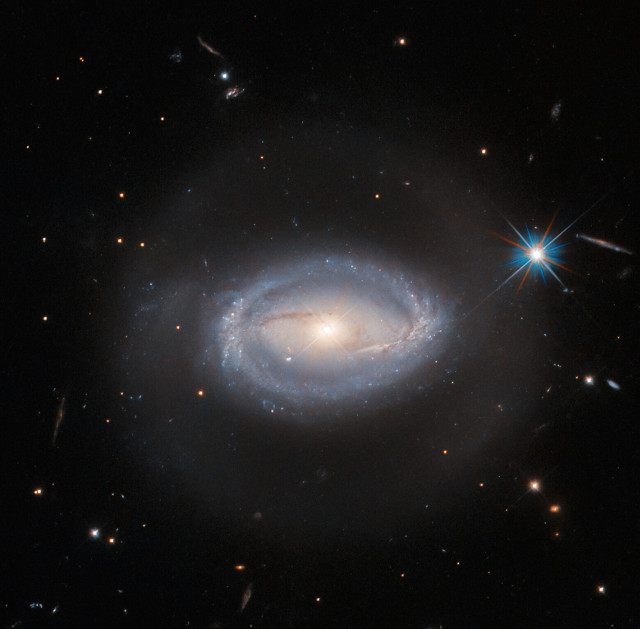
An image captured by the Hubble Space Telescope shows galaxy Z 229-15. A combination of the Advanced Camera for Surveys (ACS) and Wide Field Camera 3 (WFC3) instruments with three different filters was used to obtain observations including ultraviolet, optical, and near-infrared emissions. Z 229-15 is a galaxy that defies simple classification criteria because it has a set of features not normally found together. The result is that it fits different definitions showing how sometimes classes and subclasses of galaxies don’t have precise boundaries but can overlap making different classifications valid.
About 390 million light-years from Earth, galaxy Z 229-15 has a spiral structure, and already from that point of view, it’s quite particular because it has only two arms extending from the nucleus with an almost straight shape. At their ends, the arms connect to a ring of stars surrounding the galactic edge.
Galaxy Z 229-15 is a so-called Seyfert galaxy, a class marked by the presence of an active galactic nucleus that generates powerful electromagnetic emissions. It’s a nucleus with a supermassive black hole surrounded by materials that are heated to the point of generating the powerful emissions detected even from the Earth.
Quasars are a class of active galactic nuclei that are particularly bright due to their intense activity. Normally, quasars are billions of light-years away from Earth while galaxy Z 229-15 is in the close universe from an astronomical point of view.
Typically, quasars are so bright that the rest of their host galaxies can’t be seen. Seyfert galaxies such as Z 229-15 are an exception: in fact, the image captured by the Hubble Space Telescope also shows all the parts of this galaxy.
In the end, Z 229-15 is a spiral galaxy that also falls into the Seyfert class of galaxies that contains a quasar, which is a type of active galactic nucleus. All those classifications are valid and make this galaxy an interesting object of study for various reasons. Studying quasars is difficult when they are billions of light-years away, so the one in the center of Z 229-15 may offer more information. Many astronomical studies concern the influence of supermassive black holes on the galaxies that host them and in particular on star formation, another reason to study an active one.
