April 2023

The two quasars of SDSS J0749+2255 as seen by Hubble (Image NASA, ESA, Yu-Ching Chen (UIUC), Hsiang-Chih Hwang (IAS), Nadia Zakamska (JHU), Yue Shen (UIUC))

An article published in the journal “Nature” reports the discovery of a pair of merging galaxies cataloged as SDSS J0749+2255 which has the peculiarity of hosting a double quasar. A team of researchers led by the University of Illinois at Urbana-Champaign used various ground-based and space telescopes to study SDSS J0749+2255 to obtain observations detailed enough to resolve the two quasars, both of which are extremely bright. The difficulty in these observations is also given by the fact that this pair is very distant and we see it as it was when the universe was about three billion years old and the distance between the two supermassive black holes that power their respective quasars is only about ten thousand light-years.

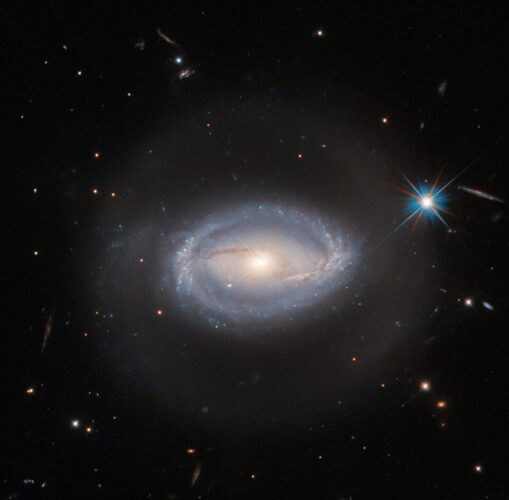
Galaxy Z 229-15 (Image ESA/Hubble & NASA, A. Barth, R. Mushotzky)

An image captured by the Hubble Space Telescope shows galaxy Z 229-15. A combination of the Advanced Camera for Surveys (ACS) and Wide Field Camera 3 (WFC3) instruments with three different filters was used to obtain observations including ultraviolet, optical, and near-infrared emissions. Z 229-15 is a galaxy that defies simple classification criteria because it has a set of features not normally found together. The result is that it fits different definitions showing how sometimes classes and subclasses of galaxies don’t have precise boundaries but can overlap making different classifications valid.

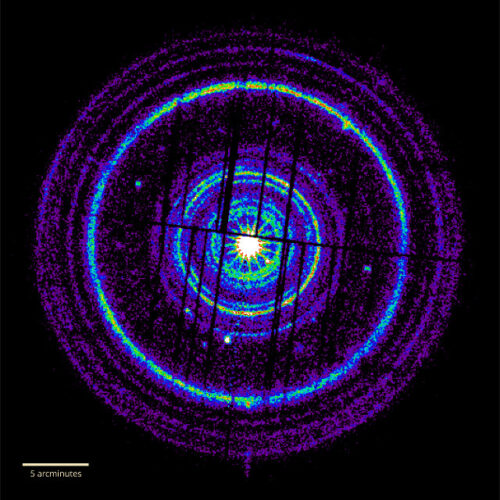
The concentric rings generated by the GRB221009A gamma-ray burst as seen by the XMM-Newton space telescope (Image ESA/XMM-Newton/M. Rigoselli (INAF))

A special issue of “The Astrophysical Journal Letters” is focused on the gamma-ray burst cataloged as GRB221009A, indicated since the first estimates of its characteristics as the gamma-ray burst of the century. Various teams of researchers conducted various types of analyzes of the data collected by many instruments that detected the emissions from GRB221009A and the so-called afterglow, meaning from the residues of its emissions, in several electromagnetic bands. The wealth of data indicates that this is the most powerful gamma-ray burst ever observed and offers new insights into these extremely energetic phenomena. In this case, it was a long gamma-ray burst, probably generated by the collapse of the core of a massive star and the subsequent birth of a black hole.