
An article published in “The Astrophysical Journal” reports a study based on the most detailed images obtained so far of the protoplanetary disk surrounding the very young star V1295 Aquilae. A team of researchers used CHARA’s array, the world’s largest optical and infrared interferometer, to obtain images of the inner area of the protoplanetary disk in detail never seen before. Despite this, the results lead to more questions than answers because they confirmed the presence of structures in the disk and emissions reported by previous studies but their characteristics still don’t have complete explanations.
Also known as HD 190073 and with other designations in various catalogs, V1295 Aquilae is a star with an estimated age of about 100,000 years. In astronomical terms, it’s a newborn star, to the point that it hasn’t yet completed its formation phase. For this reason, it’s classified in the Herbig Be class which includes stars in a phase before the main sequence in which they will spend their lives.
The mass of V1295 Aquilae was estimated to be about six times the Sun’s and this star is extremely bright, about nine hundred times the Sun. Due to the presence of a protoplanetary disk and other gas and dust surrounding it, the emissions reaching the Earth are particularly strong in infrared.
Many protoplanetary disks, in some cases with forming planets, are known but can be difficult to study. Optical telescopes and radio telescopes sensitive to millimeter waves may not have sufficient resolution to obtain images of those disks’ inner areas in particular. The system of V1295 Aquilae is one of those cases and the interferometer of the CHARA (Center for High Angular Resolution Astronomy) offered considerable help.
CHARA has the world’s largest optical and near-infrared sensitive interferometer, consisting of six telescopes working together. They offer a sensitivity comparable to that of a telescope with a 330-meter mirror.
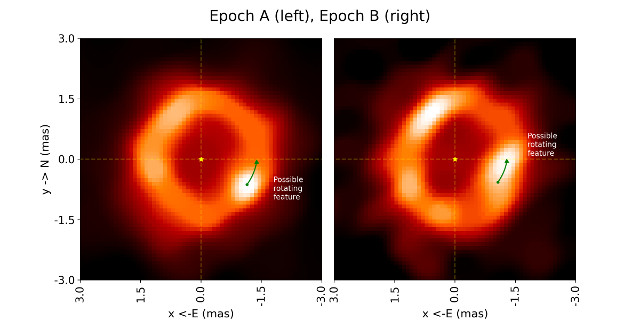
The image (Courtesy Michigan Astronomy. All rights reserved) shows the V1295 Aquilae system with its protoplanetary disk seen one month apart by the CHARA interferometric array. The inner region shows structures that could be in rotation and confirm emissions already detected in previous studies of this protoplanetary disk.
Previous studies of the V1295 Aquilae system such as Gemini-LIGHTS detected the presence of what might be a planet in the process of formation. This new study confirms that there are structures in the protoplanetary disk but the answers are only partial and lead to other questions. The abnormalities of the characteristics of the structures and of the emissions are connected to the models of the formation and evolution of protoplanetary disks.
Even the interferometric readings may not be precise enough to offer completely correct results. Another possibility is that processes that haven’t been detected are running on the outer side of the disk. These limits could also be the reason why an explanation for the radiation emissions, 15% of which comes from the inner disk area, hasn’t been found.
Being able to study the internal area of a protoplanetary disk is a step forward, but this new study of the V1295 Aquilae system shows that there is still much to discover. The researchers intend to continue studying this protoplanetary disk to gather new data that could lead to better estimates of the characteristics of the structures and the amount of radiation emitted to obtain more precise answers.
