
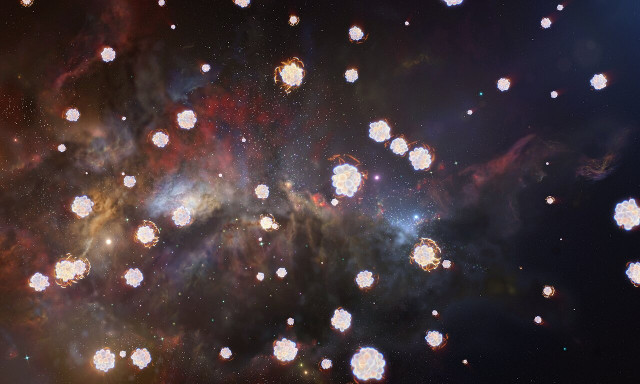
An article published in “The Astrophysical Journal” reports the identification of gas clouds dating back to around 11 billion years ago in which the “fingerprints” left by the explosion of the first stars in the universe were discovered. A team of researchers led by Andrea Saccardi, a Ph.D. student at the Observatoire de Paris – PSL, used ESO’s VLT in Chile to obtain spectrographic measurements containing the “chemical signatures” of the elements contained in the clouds through which the light picked up by the VLT traveled. The information obtained allows to take a step forward in the reconstruction of a crucial part of the early history of the universe.
The first stars in the universe contained only the hydrogen and helium generated after the Big Bang. According to current models, they formed about 13.5 billion years ago and were extremely massive thanks to the abundance of gas available at the time. Stars with masses that could be hundreds of times the Sun’s consume their hydrogen at a very fast rate and explode in supernovae after a few million years, so we can’t see them even with the most powerful instruments. However, we can look for their traces in the chemical elements they scattered throughout space.
The task led by Andrea Saccardi derives from the Master’s thesis he carried out at the University of Florence, Italy, under the supervision of Stefania Salvadori, professor of the Department of Physics and Astronomy of the University of Florence and leader of the European Nefertiti project, and Valentina D’Odorico of the Italian National Institute of Astrophysics of Trieste. The X-shooter spectrograph mounted on the Very Large Telescope (VLT) played a crucial role in this study.
The light detected by the VLT and analyzed thanks to the X-shooter instrument was emitted by quasars. These are the most powerful light sources in the universe, powered by supermassive black holes surrounded by large quantities of materials that heat up to the point of generating very strong electromagnetic emissions. This light passed through gas clouds and was modified by the chemical compounds within them, leaving a kind of chemical signature on them. X-shooter allows splitting light into a huge range of wavelengths to find the various chemical signatures. This allowed to find the chemical composition we expect from the remains of the first stars of the universe.
The first supernovae ejected elements such as carbon, oxygen, and magnesium into space. Some of those supernovae weren’t powerful enough to eject heavier elements such as iron, which is only found in the cores of those stars at the end of their lives. The low presence of iron in three very distant gas clouds rich in other elements produced by supernovae indicates that these are the remnants of some of the first supernovae.
The chemical composition detected in those three clouds of gas is very similar to that of ancient stars, including those present in the Milky Way. Second-generation stars, born from the materials ejected from first-generation stars, could be small and therefore have a very long life. This study added more information about the universe’s first stars thanks to the discovery of ancient gas clouds.
Using this method it will be possible to search for more gas clouds in the early universe with that chemical composition. It will also be possible to conduct follow-up studies of the three gas clouds discovered in this study. Valentina D’Odorico explained that ANDES (ArmazoNes high Dispersion Echelle Spectrograph), the even more advanced instrument that will be used with the ELT (Extremely Large Telescope) under construction, will make it possible to study these rare gas clouds in even more detail and we will be able to discover the mysterious nature of the first stars.
The life and death of the first stars in the universe had a remarkable influence on subsequent generations, starting scattering previously non-existent elements into space and helping to trigger the formation of new stars. For these reasons, it’s important to reconstruct their history.
