May 2023

On the right side, the disk in 2021 is shown with the already known shadow, here marked as (B), and the new shadow (C) generated by an inner disk.

An article published in “The Astrophysical Journal” reports the results of observations of the protoplanetary disk surrounding the very young star TW Hydrae. A team of researchers used observations conducted with the Hubble Space Telescope to examine the ongoing processes and evolution of planetary formation in the system. A protoplanet was identified in 2016 and that had increased the interest in that protoplanetary disk. In 2017, a shadow was identified that indicated the presence of an internal disk inclined relative to the external disk. Now a second shadow appears to come from another disk on the system’s inner side. This means that there may also be another planet in the making.

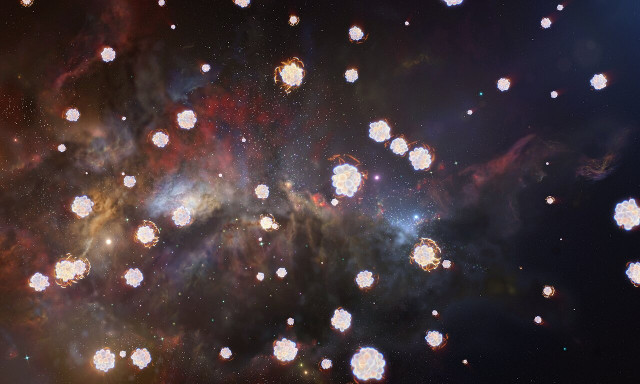
Artist's concept of various atoms in a gas cloud (Image ESO/L. Calçada, M. Kornmesser)

An article published in “The Astrophysical Journal” reports the identification of gas clouds dating back to around 11 billion years ago in which the “fingerprints” left by the explosion of the first stars in the universe were discovered. A team of researchers led by Andrea Saccardi, a Ph.D. student at the Observatoire de Paris – PSL, used ESO’s VLT in Chile to obtain spectrographic measurements containing the “chemical signatures” of the elements contained in the clouds through which the light picked up by the VLT traveled. The information obtained allows to take a step forward in the reconstruction of a crucial part of the early history of the universe.

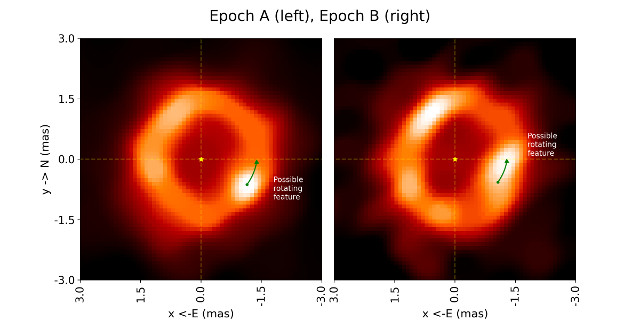
The V1295 Aquilae system with its protoplanetary disk seen one month apart by the CHARA interferometric array

An article published in “The Astrophysical Journal” reports a study based on the most detailed images obtained so far of the protoplanetary disk surrounding the very young star V1295 Aquilae. A team of researchers used CHARA’s array, the world’s largest optical and infrared interferometer, to obtain images of the inner area of the protoplanetary disk in detail never seen before. Despite this, the results lead to more questions than answers because they confirmed the presence of structures in the disk and emissions reported by previous studies but their characteristics still don’t have complete explanations.

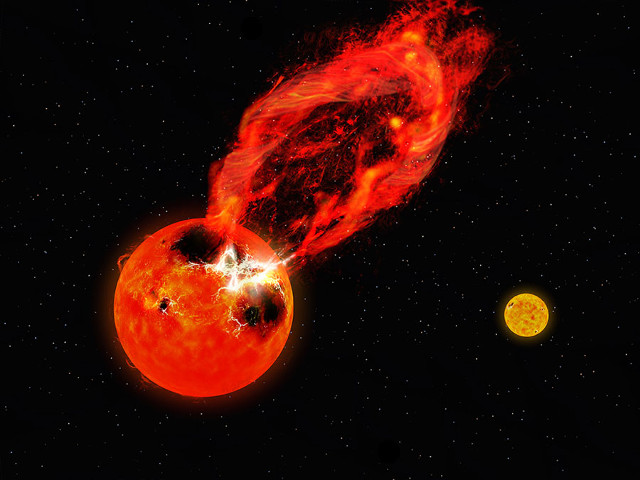
Artist's concept of the superflare in the Orionis V1355 system (Image courtesy National Astronomical Observatory of Japan)

An article published in “The Astrophysical Journal” reports the detection of a superflare in the V1355 Orionis system, a pair of stars of the variable RS Canum Venaticorum type, which features a more massive and evolved star than its companion. A team of researchers used space and ground-based telescopes to monitor the activity of the V1355 Orionis system, known for its powerful eruptions. This allowed to obtain continuous observations of this phenomenon, which was generated by a process called prominence eruption. This study offers new insights into these stellar phenomena that also occur on the Sun, albeit with a much smaller force.