
An article being published in the journal “Astronomy & Astrophysics” reports a study of what were compared to shooting stars, observed in details never obtained before together with the solar corona. A team of researchers coordinated by Northumbria University in Newcastle used observations conducted by ESA’s Solar Orbiter space probe to study what are actually clumps of plasma that can be up to 250 kilometers wide, a coronal rain that falls on the surface of the Sun. That plasma heats up to a few million degrees, a state that lasts a few minutes during the fall until it condenses following its quick drop in temperature.
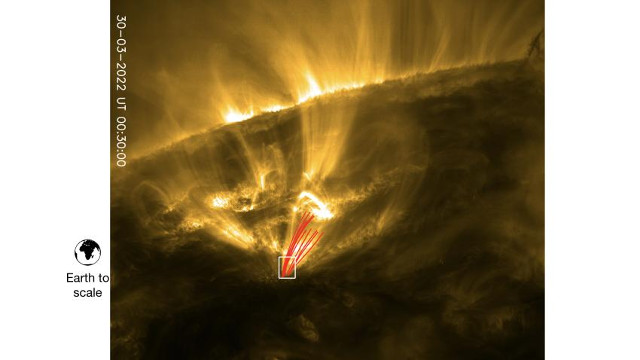
The image (Courtesy Patrick Antolin. Background: ESA/Solar Orbiter EUI/HRI) shows a partial section of the Sun photographed by the Solar Orbiter space probe’s EUV instrument with gas at a temperature of around one million degrees Celsius. The red lines indicate some of the coronal rain paths analyzed in this study. A drawing of the Earth to scale next to the photo gives an idea of the size of the area photographed.
Launched on February 10, 2020, the Solar Orbiter space probe, or simply SolO, is one of the missions currently studying various aspects of the Sun’s activity. In this case, it’s an ESA mission developed in collaboration with NASA.
During spring 2022, the Solar Orbiter space probe passed at a distance of about 49 million kilometers from the Sun. That’s almost as close as SolO is flying to the Sun which made it possible to obtain the best spatial resolution of the images of the solar corona. The Extreme Ultraviolet Imager (EUI) and Spectral Imaging of the Coronal Environment (SPICE) instruments in particular captured details of the coronal rain.
On Earth, a meteor shower can start with lots of objects entering the atmosphere but most of them disintegrate due to friction. The solar corona is thin, so it doesn’t strip much material off the clumps. As a consequence, scientists think most of it reaches the Sun’s surface intact.
However, until now it wasn’t possible to observe the impact of coronal rain but at last, SolO’s observations were successful. The captured images revealed that that impact can produce a bright flash with materials shooting up and shock waves that reheat the gas above it.
Another difference from meteorites is that plasma clumps don’t generate visible tails as they fall. That’s due to the plasma being ionized and therefore harnessed by magnetic field lines and being sucked in and funneled as if it had ended up in giant tubes. The underlying compression and heat prevent the clumps from producing tails and consequently makes this phenomenon much more difficult to detect on the Sun.
The observation of coronal rain with the quick temperature changes of the clumps offers new information useful to understand the processes taking place in the solar atmosphere. One of the biggest mysteries still without a precise explanation concerns the fact that the outermost part of that atmosphere can reach temperatures of up to 2 million degrees Celsius while the surface reaches less than 6,000° Celsius. The coronal rain seems to be more important than expected, offering new insights for the continuation of the studies.
