
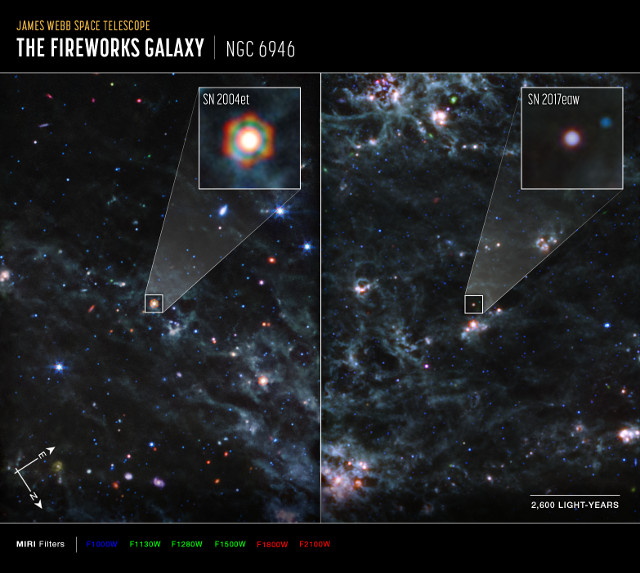
An article published in the journal “Monthly Notices of the Royal Astronomical Society” reports the identification of large amounts of dust from two supernovae in the galaxy NGC 6946. A team of researchers used the James Webb Space Telescope to find traces of dust coming from the supernovae SN 2004et and SN 2017eaw exploiting in particular the potential of the MIRI instrument. The result is the discovery of large amounts of dust among the material ejected from each of the two supernovae and this supports the theory that in the early universe, supernovae played a key role in producing dust.
Dust forms a sort of building block in the formation of many objects in the universe, especially planets. The elements that are transported into interstellar space by the dust are crucial in the formation of new generations of stars and above all planets.
Supernovae have long been thought to produce the large amounts of dust that form when the hot gas ejected from exploding stars cools down. The problem so far was that it was difficult to detect that dust around supernova remnants, a feat achieved only by studying supernova 1987A, about 170,000 light-years from Earth. That wasn’t enough to prove that supernovae produced the dust found in various young galaxies in the early universe.
The now-cold dust around the remnant of a supernova is detectable in the mid-infrared but an instrument with sufficient sensitivity is required. Until recently, there was no instrument capable of detecting those emissions in a galaxy like NGC 6946, about 22 million light-years from Earth, but the James Webb Space Telescope’s Mid-Infrared Instrument (MIRI) was designed to obtain performance at a level good enough to detect emissions from dust even at that distance.
In the case of the supernova SN 2004et, the researchers were also able to estimate the amount of dust detected by the James Webb Space Telescope in more than 5,000 Earth masses. The researchers warn that the amount could be even higher but if it’s colder, it may not be detectable even by Webb or some of the emissions may be obscured by the outermost dust layers.
Finding out how much dust survives the shock waves following a star explosion was one of the researchers’ goals. This study offers a positive result, meaning that it suggests that dust can survive such shocks and that supernovae do indeed produce large amounts of dust.
Supernovae SN 2004et and SN 2017eaw are the first two of five observation targets with the James Webb Space Telescope. The positive results also offer interesting possibilities for obtaining information on the characteristics of a supernova and the core of the progenitor star. This will require follow-up observations to monitor the remnants over time in a task that could take years to bring new discoveries about supernovae and the role that the death of massive stars has on the evolution of galaxies and the formation of new planets.
