July 2023

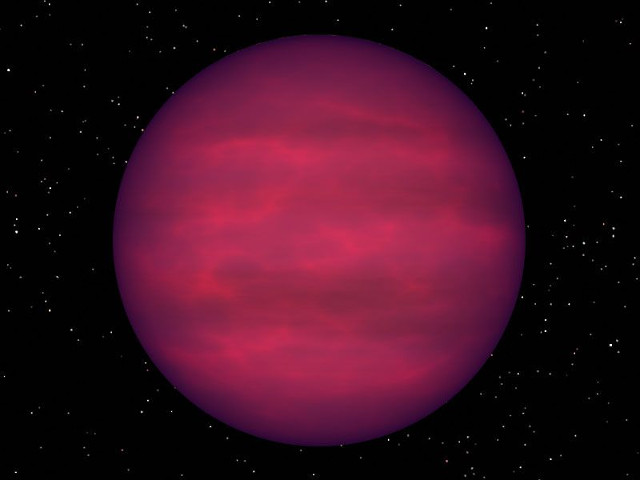
Artist's concept of T-class brown dwarf (Image R. Hurt/NASA)

An article published in “The Astrophysical Journal Letters” reports the detection of radio emissions from the brown dwarf cataloged as WISE J062309.94−045624.6, the smallest known in the field of radio astronomy. A team of researchers used the ASKAP, Australian Telescope Compact Array, and MeerKAT radio telescopes to obtain the measurements necessary to establish the nature of the object. Typically, a brown dwarf smaller than Jupiter doesn’t emit radio waves, making WISE J062309.94−045624.6 an interesting astronomical research target.

The launch of Chandrayaan 3 mission (Image courtesy ISRO)

A little while ago, a GSLV Mk-III rocket blasted off from India’s Satish Dhawan Space Centre with the Chandrayaan 3 mission’s Vikram lander and Pragyaan rover. After just over 16 minutes, the vehicles separated from the rocket’s last stage to begin the series of maneuvers that will gradually stretch their orbit until they are brought into the area of influence of the Moon, where the lander and rover will land on August 23 in this follow-up to the Chandrayaan 2 mission.

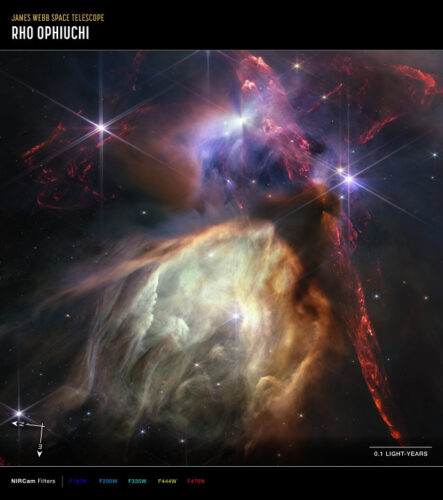
A part of the Rho Ophiuchi complex

An image of part of the Rho Ophiuchi complex captured by the James Webb Space Telescope was chosen to mark the first anniversary of the release of the first official images in astronomy’s new flagship instrument’s science mission. The NIRCam instrument captured details of this giant molecular cloud that forms one of the closest star-forming regions to Earth. Delays and various problems had led to postpone many time Webb’s launch date but in the last year, all the promises of progress in the field of astronomy have been kept and this is only the beginning.

Artist's concept of the exoplanet LTT 9779 b and its star (Image courtesy Ricardo Ramírez Reyes (Universidad de Chile)

An article published in the journal “Astronomy & Astrophysics” reports a study on the exoplanet LTT 9779 b, an ultrahot Neptune that was defined as the largest mirror in the universe because it reflects about 80% of the light it receives from its star. A team of researchers used observations conducted with ESA’s CHEOPS space telescope to study LTT 9779 b. They were able to calculate what is technically called albedo, the amount of light it reflects, in this case at exceptional levels. The conclusion is that such an extreme albedo is due to reflective metal clouds.

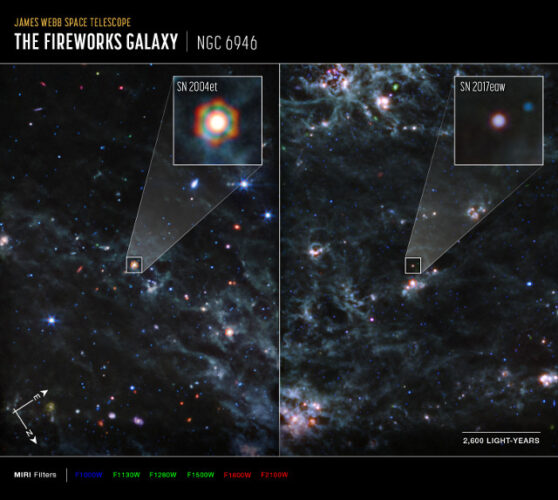
The SN 2004et and SN 2017eaw supernova remnants (Science: NASA, ESA, CSA, Ori Fox (STScI), Melissa Shahbandeh (STScI). Image Processing: Alyssa Pagan (STScI))

An article published in the journal “Monthly Notices of the Royal Astronomical Society” reports the identification of large amounts of dust from two supernovae in the galaxy NGC 6946. A team of researchers used the James Webb Space Telescope to find traces of dust coming from the supernovae SN 2004et and SN 2017eaw exploiting in particular the potential of the MIRI instrument. The result is the discovery of large amounts of dust among the material ejected from each of the two supernovae and this supports the theory that in the early universe, supernovae played a key role in producing dust.