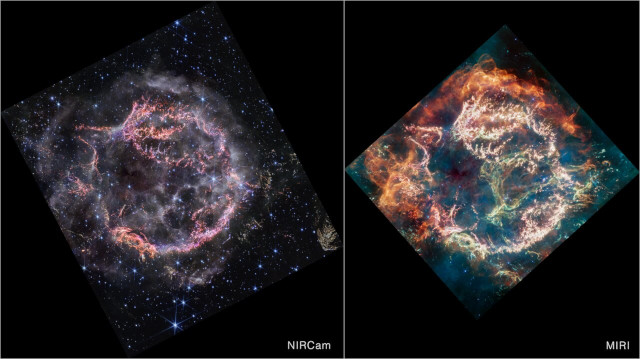
An image of the Cassiopeia A supernova remnant (NASA, ESA, CSA, STScI, Danny Milisavljevic (Purdue University), Ilse De Looze (UGent), Tea Temim (Princeton University)), or simply Cas A, captured by the James Webb Space Telescope’ NIRCam instrument shows new details of the structures present among the materials surrounding what remains of the progenitor star. In April 2023, images captured by another Webb instrument, MIRI, were published, showing different details of Cassiopeia A. The reasons why certain structures are invisible to NIRCam are also being studied.
There are no traces in historical records of observations of the light from the supernova Cassiopeia A even though it should have reached Earth about 340 years ago. However, after its remnant was discovered, it’s been studied many times, recently, using the James Webb Space Telescope’s instruments.
The Mid-InfraRed Instrument (MIRI) already offered interesting details of Cassiopeia A that are useful for astronomers in studies such as those of cosmic dust and the diffusion of chemical elements produced by the progenitor star and the supernova. Now the Near-Infrared Camera (NIRCam) instrument shows different details, in some ways less rich if we look only at the colors, but this depends on the infrared frequencies of the various observations.
The NIRCam captured details visible also zoomed in the insets of the top image. In n. 1, small knots of gas including sulphur, oxygen, argon, and neon are visible coming from the star. In n. 2 emissions in white and purple are visible and represent ionized gas and are probably due to supernova debris passing through the shell of gas emitted by the progenitor star before the explosion. N. 3 shows a sort of light echo of the explosion that is created when the light emitted by the supernova reaches and heats distant dust, which glows as it cools down. N. 4 shows another echo, dubbed Baby Cas A, which is particularly intricate and large and is about 170 light-years behind the supernova remnant.
In the main inner shell and in the bubble-shaped shells in the lower half of the inner cavity, white areas are visible. That’s light emitted by synchrotron radiation, also emitted in the near-infrared. This radiation is generated by energetic particles traveling at extremely high speeds in spiral trajectories around magnetic field lines.
The images captured by the MIRI instrument in the mid-infrared showed the peripheral regions of Cassiopeia A’s inner shell in an orange and red color. Their details become much fainter and were compared to that of smoke from a campfire. The dust in circumstellar material is too cold to be seen in the near-infrared while it glows in the mid-infrared. The green ring in the central cavity of Cassiopeia A is also bright in the MIRI images while disappearing in the NIRCam ones.
Astronomers studying this supernova remnant are interested in differences in observations with different instruments that capture different infrared frequencies, visible in the bottom image (NASA, ESA, CSA, STScI, D. Milisavljevic (Purdue University), T. Temim (Princeton University), I. De Looze (University of Gent)). The colors we see in the various images are “converted” from infrared ones to allow us to study them. Understanding why certain areas are bright at certain frequencies and not at others helps to understand the processes underway and their evolution over time. Those are processes that create the cosmic show that the James Webb Space Telescope allows us to admire more than ever and at the same time are spreading new chemical elements in interstellar space that could help form new planets.