
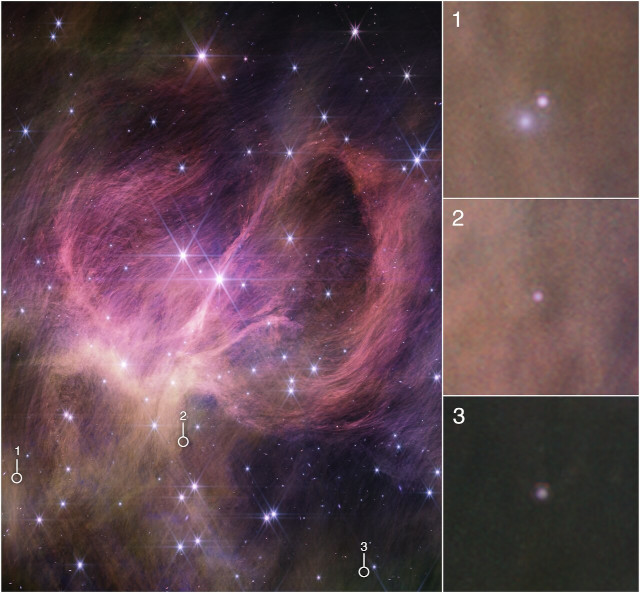
An article published in “The Astronomical Journal” reports the discovery of three brown dwarfs in the star formation area cataloged as IC 348, part of the large Perseus Cloud. A team of researchers used the James Webb Space Telescope to study that area searching for brown dwarf candidates and identifying three with masses less than eight times Jupiter’s. The smallest of them has a mass estimated between three and four times Jupiter’s, making it the smallest known brown dwarf. Two of them show the chemical signatures of an unidentified aliphatic hydrocarbon whose presence is not predicted by any atmospheric model.
The image (NASA, ESA, CSA, STScI, and K. Luhman (Penn State University) and C. Alves de Oliveira (European Space Agency)) shows the central area of the star-forming area IC 348 seen by the James Webb Space Telescope’s NIRCam instrument. Zooms in the insets show the three brown dwarfs discovered in this study.
Brown dwarfs have been known for just over twenty years, although their existence was theorized much earlier. They are called failed stars because their mass is not enough to trigger hydrogen fusion. They can also offer information on the gas giant planets due to the similarities between them. The advantage over exoplanets is that they are generally much farther away from a star and its light, so there’s less interference in observations.
About 1,000 light-years from Earth, the IC 348 cluster hosts young stars, as it has an estimated age of just five million years. These are mainly low-mass stars and in the past, that already offered the hope of finding smaller objects, brown dwarfs. Given their young age in astronomical terms, brown dwarfs are relatively bright in the infrared emitted thanks to the heat accumulated during their formation. Detecting older brown dwarfs is much more difficult precisely because their emissions are fainter even in the infrared.
The James Webb Space Telescope’s Near-Infrared Camera (NIRCam) instrument was used to find objects with a brightness compatible with that of a young brown dwarf. The most promising candidates were subsequently subjected to follow-up observations with another instrument, NIRSpec (Near-Infrared Spectrograph).
Eventually, the researchers identified three brown dwarfs with masses between three and eight times Jupiter’s that have surface temperatures between 850 and 1,500° Celsius. The smallest has a mass estimated between three and four times Jupiter’s, and this makes its formation difficult to explain. According to models, brown dwarfs form like stars from clouds that have limited mass. The problem is that a cloud that is too small would have too little mass to trigger the collapse necessary to generate a brown dwarf.
The researchers considered the possibility that the smallest brown dwarf is actually a so-called rogue planet, a planet that was ejected from its star system. Since the stars in the IC 348 area are mostly small, it’s unlikely that such a massive planet could have formed around one of them. The young age of the objects in that area makes it even more unlikely that a planet was already ejected and is so far away from all the stars.
Another surprise came from the discovery of the chemical signature of an aliphatic hydrocarbon in the spectroscopic data collected by the NIRSpec instrument. The data offer an imprecise identification, in the sense that they don’t allow to establish the exact structure of the detected molecule. That’s the same chemical signature detected by the Cassini space probe in the atmospheres of Saturn and its moon Titan and by other instruments in the interstellar medium.
This is the first detection of an aliphatic hydrocarbon outside the solar system. The researchers can’t rule out that there is actually more than one molecule of that type. No atmospheric model of brown dwarfs predicts the formation of this type of compound and for now, it’s only possible to offer a few hypotheses on their origin.
This study offered interesting results and some surprises, leaving open possibilities for further investigation. Longer observations could lead to the detection of objects even smaller and dimmer than the discovered brown dwarfs. This would provide more useful information to understand whether there could be rogue planets in the IC 348 area, obtain other hydrocarbon detections, and perhaps have other surprises.
