
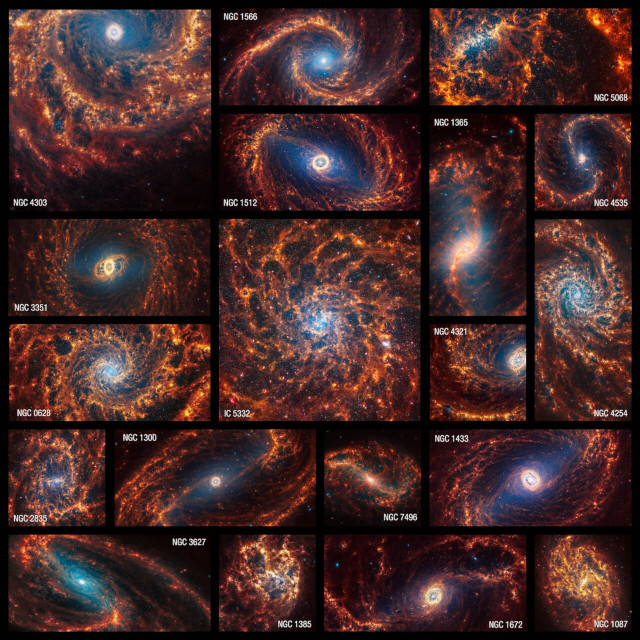
The images of 19 spiral galaxies (Mosaic image NASA, ESA, CSA, STScI, J. Lee (STScI), T. Williams (Oxford), PHANGS Team, E. Wheatley (STScI)) captured by the James Webb Space Telescope have been released as part of the PHANGS (Physics at High Angular resolution in Nearby GalaxieS) project. These are galaxies up to 65 million light-years away that we see face-on, and this allows to better observe the stars inside them, an optimal situation for a project focused on star formation processes. Webb’s NIRCam (Near-Infrared Camera) and MIRI (Mid-Infrared Instrument) instruments were employed to cover the near and mid-infrared resulting in many new details.
The PHANGS project is a broad international astronomical collaboration that exploits some of the most powerful instruments in existence to study star formation in different electromagnetic bands. This allows to capture details detectable only at certain frequencies and combine the different results to obtain a more precise and complete picture of the processes taking place in the observed galaxies.
Especially in the past, the Hubble Space Telescope provided observations ranging from ultraviolet to visible frequencies up to the near-infrared. Many stellar nurseries were revealed and mapped thanks to the MUSE (Multi-Unit Spectroscopic Explorer) instrument mounted on the VLT (Very Large Telescope) and the ALMA radio telescope.
Almost a year ago, the first results of the PHANGS project using the James Webb Space Telescope were presented. Now these new results obtained with Webb offer new details that amazed even expert researchers. Many structures are visible at much smaller scales than can be seen with other instruments and that’s very useful in astronomical studies.
Near-infrared detections obtained with the NIRCam instrument are visible in blue tones in the images with millions of stars in spiral arms and star clusters. Mid-infrared detections obtained with the MIRI instrument show bright dust around and between stars. In shades of red, it shows stars that are still forming wrapped in cocoons of gas and dust. Spherical shells amid gas and dust may have been created by supernovae that dig holes in the interstellar material.
The spiral arms can be traced until extended regions of gas appear red and orange. Those are structures that tend to follow the same pattern in certain parts of galaxies, and astronomers think of them as waves with a spacing that says a lot about how a galaxy distributes gas and dust. Their detailed study offers crucial information for understanding how galaxies initiate, maintain, and stop star formation.
Evidence gathered by astronomers shows that galaxies grow from the inside out with star formation starting in their cores and spreading into their arms. This means that the further away a star is from the galactic core, the younger it’s likely to be. In contrast, the areas close to the core visible in shades of blue are populations of old stars.
However, sometimes, pink and red tones are visible in galactic cores. That’s interpreted as a clear sign that there’s an active supermassive black hole or that star clusters near the center are so bright that they saturated that area of the image.
The PHANGS collaboration has also made public a catalog of around 100,000 star clusters. That’s a colossal amount of data that adds to that collected in other electromagnetic bands in recent years and which has now been made available to the scientific community.
The various surveys conducted with the instruments used by the PHANGS collaboration are helping to precisely catalog the various types of stars, a crucial step in reconstructing their life cycles. This is also how the PHANGS project is contributing to obtaining a comprehensive view of the processes related to the stars’ birth, life, and death. One of the consequences is the possibility of predicting the evolution of galaxies in the future, and this also concerns the Milky Way.
