
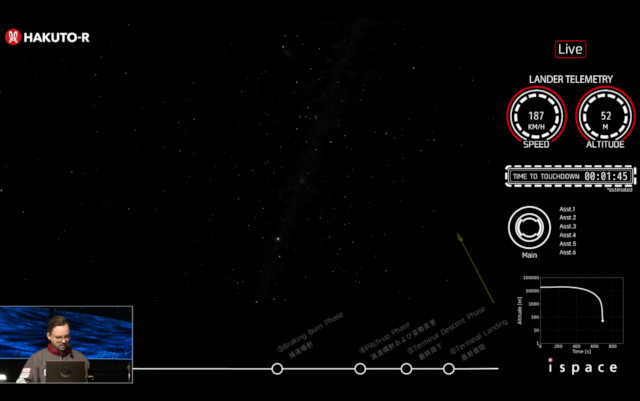
It was early morning in Tokyo when the Hakuto-R Resilience lander of the Japanese company ispace inc. attempted the Moon landing. For the people who watched the conclusion of the first Hakuto-R lander’s mission, the end of Resilience’s mission unfortunately offered a sense of deja vu. This time, the telemetry transmission was interrupted less than two minutes before the Moon landing, when the speed was measured at 187 km/h at an altitude of 52 meters (see image courtesy ispace inc.). This was the so-called Phase 4, during which Resilience was supposed to decelerate. The clear impression is that something went wrong, and this second mission also ended in a crash.
The staff at the ispace mission control center tried to resume communications with the Resilience lander. However, after several minutes, the live broadcast ended with the sole promise of having updates as soon as possible. In essence, there was an understandable attempt to cling to the last hopes of obtaining a new contact, but the prospects at that point were negative indeed.
An update arrived a couple of hours later and postponed the official outcome of the Resilience lander mission with the announcement of a press conference by ispace. As was unfortunately expected, it was confirmed that, in all likelihood, there was a crash on the Moon.
Launched on January 15, 2025, atop a Falcon 9 rocket, the Hakuto-R Resilience lander represented the second attempt to land a spacecraft on the Moon by ispace on a commercial mission. The basic design remained the same, with updates made after studying the telemetry data collected during the first mission.
According to the statements released, the first examination of the telemetry data showed that the attitude of the Resilience lander was almost vertical, but the laser rangefinder encountered delays in obtaining valid measurements of the distance to the Moon’s surface. The consequence was the impossibility of decelerating sufficiently for the landing, and therefore, there was a crash.
For ispace, the second failure is a big blow. However, the company’s American subsidiary has a contract to send another, larger lander called Apex to the Moon in 2027. For this reason, only some of the information collected in the two Hakuto-R lander missions will be useful, but the pressure will be considerable.
