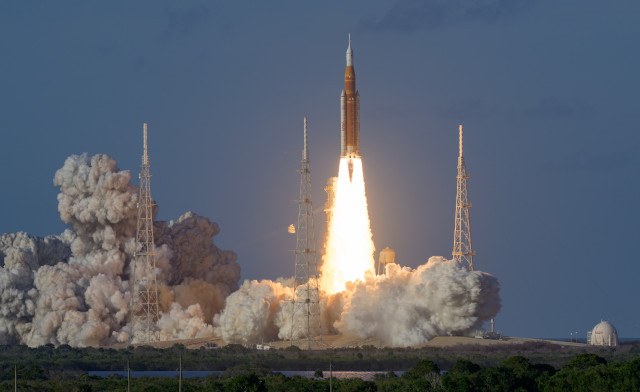
It was afternoon in the USA when NASA’s Orion spacecraft separated from the last stage, called the ICPS (Interim Cryogenic Propulsion Stage), of the Space Launch System (SLS), which blasted off almost two hours earlier from the Kennedy Space Center. The Orion entered the trajectory that will take it around the Moon to carry out its mission, which will last about 10 days. This is the second launch for the SLS and for the Orion in its full configuration. The Artemis II mission is important because it’s the first of this program to have a crew aboard.
Nearly three and a half years after the Artemis I mission, the second mission of this program, aimed at returning astronauts to the Moon, has finally launched. This program’s ultimate goal is to build a permanent base on the Moon, following plans that have been modified over time. The program’s current version was announced at a NASA event just last week.
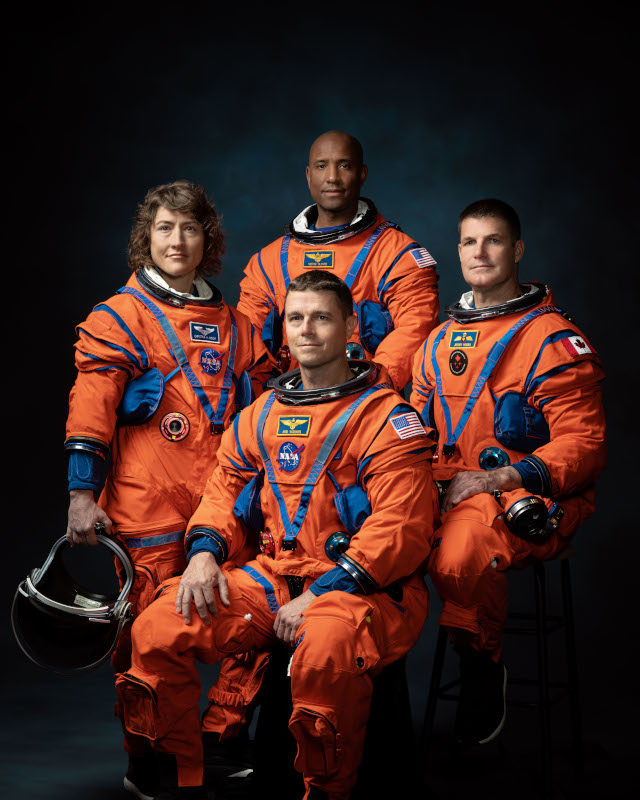
The four astronauts aboard the Orion spacecraft, which was named Integrity, are:
Gregory Reid Wiseman. Born on November 11, 1975, in Baltimore, Maryland, USA, graduated in engineering from Rensselaer Polytechnic Institute. He joined the Navy with the NROTC (Naval Reserve Officers Training Corps) program and was trained as an airplane pilot. He served two tours in the Middle East, for which he received some honors and also obtained a master’s degree in systems engineering from Johns Hopkins University in 2006. In 2009, he was selected as an astronaut candidate, and this is his first experience in a space mission. Between May and September 2014, he served on the International Space Station as part of Expedition 40/41.
Victor Jerome Glover. Born on April 30, 1976, in Pomona, California, USA, he earned a Bachelor of Science in engineering from California Polytechnic State University in 1999 before joining the US Navy. During his service, he became a test pilot, earned a Master’s in Test Flight Engineering from Air University in 2007, a Master’s in Systems Engineering from Naval Postgraduate School in 2009, and a Master’s of Military Operational Art and Science in 2010. He was selected as an astronaut candidate in 2013. Between November 2020 and May 2021, he served on the International Space Station as part of Expedition 64/65.
Christina Hammock Koch. Born on January 29, 1979, in Grand Rapids, Michigan, USA, she earned a Bachelor of Science in electrical engineering and one in physics from North Carolina State University and a Master of Science in electrical engineering. Initially, she worked for NASA as an engineer at the Goddard Space Flight Center giving her contribution to the development of various scientific missions. She also served at the Amundsen-Scott South Pole Station and at Palmer Station in Antarctica. After that experience, she worked at Johns Hopkins University, still contributing to the development of various instruments for the Van Allen and the Juno space probes. After another experience at Palmer Station, she also worked in Greenland and for NOAA in Alaska. She was selected as a NASA astronaut candidate in 2013. Between March 2019 and February 2020, she served on the International Space Station as part of Expedition 59/60/61.
Jeremy Roger Hansen. Born on January 27, 1976, in London, Ontario, Canada, he earned a glider pilot’s license at 16 and a private pilot’s license at 17. He earned a bachelor’s degree in space science from the Royal Military College of Canada (RMC) in Kingston in 1999 and a master’s degree in physics in 2000. He served in the Canadian Armed Forces as a flight officer, receiving advanced training on various models of combat aircraft. In 2009, he was selected as a candidate by the Canadian Space Agency, for which he served in various capacities. In 2014, he participated in the NEEMO 19 submarine mission. He’s on his first space mission.
The Artemis I mission lasted almost a month and was designed to test various trajectories for the Orion spacecraft. The Artemis II mission is intended to carry astronauts around the Moon and back over a significantly shorter duration. From the moment it went into the Earth’s orbit, crew members began conducting onboard systems tests.
Only after the end of the first tests and a series of maneuvers, Orion will perform the translunar insertion maneuver, which will place it on a course that will take it around the Moon, including its far side. Among the many tests that will be conducted during the voyage is that of an optical communications system.
Many tests and experiments concern the crew’s physiological reactions in deep space, using detection and collection instruments far more sophisticated than those available during the Apollo program. The duration of the Artemis II mission is much shorter than the previous one, partly because it’s the first of the Orion spacecraft with a crew beyond Earth orbit. The results of the crew members’ tests during and after the mission will be invaluable in assessing their health and, therefore, for the next missions of the Artemis program.
The Orion Integrity spacecraft is on its complex journey that will carry astronauts into deep space. If all goes as planned, it will proceed to travel beyond Earth’s orbit. In a turbulent time for humanity, looking beyond our own backyard can help us gain a perspective that’s far broader than petty interests.