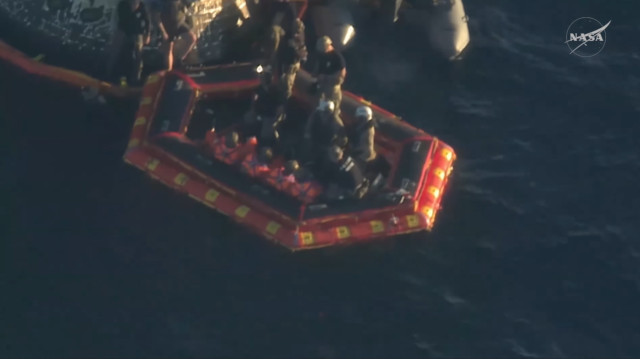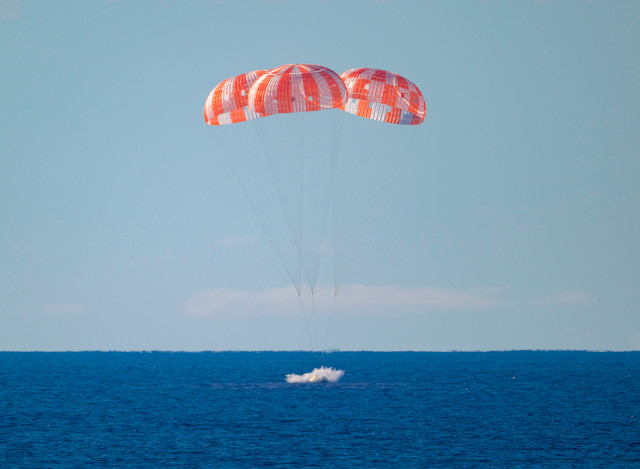
It was afternoon in the USA when NASA’s Orion Integrity spacecraft concluded its Artemis II mission by splashing down off the coast of San Diego. It launched on April 2 atop NASA’s Space Launch System (SLS). Some support ships were in the area to recover Integrity and rescue astronauts Christina Koch, Victor Glover, Reid Wiseman, and Jeremy Hansen. Everything salvageable was recovered, such as the splashdown system’s parachutes, to gather as much data as possible on the critical phase of the return to Earth.
The Artemis II mission marked some milestones for the American space program. It was the first crewed mission aboard an Orion spacecraft and the first human launch on the SLS. It was also the first space mission since Apollo 17 in 1972 to carry humans out of Earth orbit.
On April 6, the Orion Integrity spacecraft began its lunar flyby. During the passage around the far side of the Moon, there was the expected communications blackout that lasted nearly an hour. At the end of that passage, Integrity entered what is called a free-return trajectory, in which the pull of Earth’s gravity brought it back into its sphere of influence.
The reentry into Earth’s atmosphere was the fastest ever achieved by a crewed mission, approaching 40,000 kilometers per hour. The Artemis I mission had ended with a maneuver that had the Orion bounce off Earth’s atmosphere and then descend at a slower speed. However, wear detected on the heat shield led NASA to decide against that maneuver.
During the Artemis II mission, the astronauts’ communications throughout the various phases of the Orion Integrity spacecraft’s journey were positive. The toilet problems weren’t exactly glamorous, but they did remind us how, in space, everything we take for granted can become problematic due to the very different conditions.
Now, there will now be a long phase of in-depth analysis of the data collected by the Orion spacecraft’s instruments, especially about the crew. An important phase will consist of medical examinations of the astronauts to obtain information with the most modern instruments that will add to that collected during the mission.
The results will determine the timeline for the Artemis III mission, which is currently scheduled to take place in 2027 and will also carry four astronauts aboard the Orion. The plans have been modified several times over the years, so future developments may also change. The availability of the other vehicles needed for the Moon missions will also impact the timeline of the future Artemis missions.