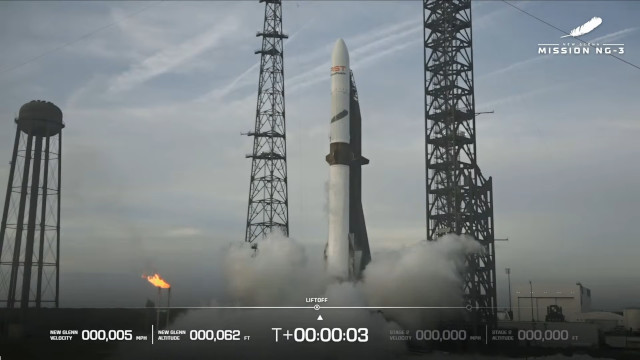
Confirmation has been received that AST SpaceMobile’s Bluebird 7 satellite will fall back to Earth after entering an orbit too low to reach the required level for direct cell phone communications. The problem emerged on Sunday, shortly after separation from Blue Origin’s New Glenn rocket’s second stage. Initial investigations quickly identified the mishap as a consequence of a malfunction of the second stage.
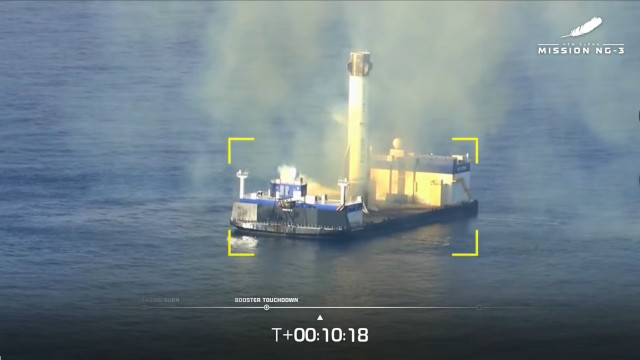
During the mission, the first stage performed properly, marking the first successful launch of a New Glenn rocket with a used first stage. The cost of the Bluebird 7 satellite will likely be covered by insurance, but the implications of this failure for Blue Origin remain to be seen, including the ramifications for the potential use of New Glenn in NASA’s Artemis program.
AST SpaceMobile is building a constellation of satellites specialized in direct cell phone communications. Some Bluebird satellites have already been launched, and last Sunday it was the turn of Bluebird 7, a key satellite in the expansion of the constellation with the new version, very big and powerful. The launch was supposed to be significant, especially since Blue Origin was planning its first launch of the New Glenn rocket with a used first stage.
Nicknamed “Never Tell Me the Odds,” this first stage was launched for the first time on November 13, 2025, and successfully landed on the Jacklyn marine platform. It should be noted that the BE-4 engines of this first stage were replaced with new ones, but the rest was largely unchanged from the previous mission. Blue Origin plans to reuse those engines for other first stages.
On Sunday’s NG-3 mission, the “Never Tell Me the Odds” first stage again performed its duty and landed successfully for the second time. It will be overhauled again and could fly for the third time. The issue likely emerged with the second stage for reasons currently under investigation by Blue Origin. Telemetry data immediately shows if a payload ends up in the wrong orbit, and this also happened with the Bluebird 7 satellite. In such a case, the satellite owner must assess whether the onboard fuel can alter its trajectory to enter a suitable orbit to carry out its mission. AST SpaceMobile’s response was negative, meaning Bluebird will fall back to Earth.
Such a case could have several consequences. For AST SpaceMobile, there could be significant delays in the progress of building its satellite constellation. For Blue Origin, the consequences will depend on the time needed to identify the cause of the problem that turned the mission into a failure and the possible need to modify the second stage of the New Glenn rocket if it turns out the problem was a design flaw and not in that specific second stage.
The orbit into which the Bluebird 7 satellite ended up is elliptical, with estimated altitudes between 154 and 494 kilometers. The planned orbit was essentially circular at an altitude of approximately 494 kilometers. For this reason, it suffers from decay due to atmospheric friction. Initial estimates suggest it could disintegrate within a few weeks, but AST SpaceMobile hasn’t provided a precise timeframe.
In these cases, simulations are conducted to determine whether the use of onboard fuel could be useful for a controlled reentry that would cause the satellite’s “clean” disintegration without generating dangerous debris. This is a very large satellite, weighing over 6,000 kilograms, so useful maneuvers are difficult to assess and plan.
This failure has ruined Blue Origin’s celebration of the first successful reuse of a used first stage. It’s nevertheless a very significant event in the aerospace industry, as it breaks SpaceX’s monopoly on the reuse of first stages for orbital missions. The mood is likely worse among AST SpaceMobile executives, also after seeing a 15% drop in the company’s stock value following the loss of the Bluebird 7 satellite.