September 2026

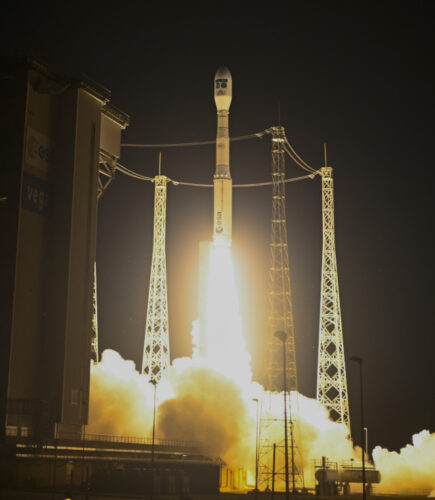
The Sentinel-3C and FLEX satellites lift off atop a Vega-C rocket (Photo: ESA–S. Corvaja. ESA Standard Licence)

A few hours ago, the Sentinel-3C, part of the GMES/Copernicus program, and the FLEX satellites were launched from the space center in French Guiana atop a Vega-C rocket. After approximately an hour, Sentinel-3C separated from the rocket’s final stage, the adapter known as Vespa. About 57 minutes later, FLEX also separated from Vespa. Their final orbit is sun-synchronous, meaning they will pass over a specific area of ​​Earth at the same local time, at an altitude of approximately 815 kilometers.

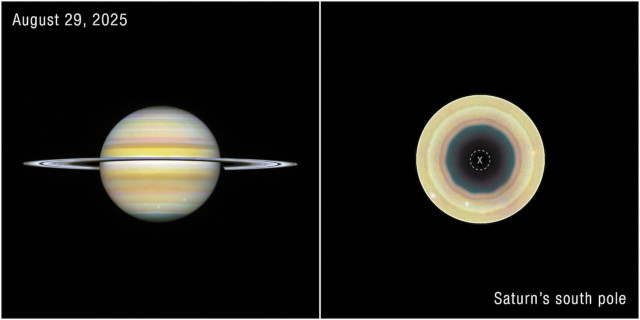
Two views of Saturn obtained with the Hubble Space Telescope. On the right, a view of the planet's south pole, with the decagon that is the subject of this study

An article published in the journal “Science Advances” reports the discovery of a decagon-shaped structure at the planet Saturn’s south pole. A team of researchers led by Professor Agustín Sánchez-Lavega of the University of the Basque Country combined observations conducted with the Hubble Space Telescope between 2023 and 2025. They observed an evolution of this structure, which was initially only vaguely defined and then took on more defined contours. This decagon has similarities to the hexagon at Saturn’s north pole but also exhibits some differences. The researchers believe it could be generated by a new atmospheric phenomenon.