
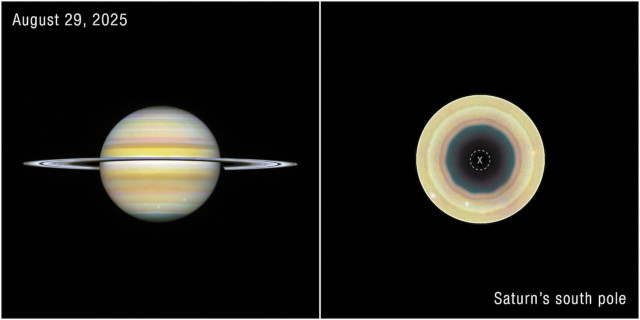
An article published in the journal “Science Advances” reports the discovery of a decagon-shaped structure at the planet Saturn’s south pole. A team of researchers led by Professor Agustín Sánchez-Lavega of the University of the Basque Country combined observations conducted with the Hubble Space Telescope between 2023 and 2025. They observed an evolution of this structure, which was initially only vaguely defined and then took on more defined contours. This decagon has similarities to the hexagon at Saturn’s north pole but also exhibits some differences. The researchers believe it could be generated by a new atmospheric phenomenon.
The image (NASA, ESA, STScI, A. Sánchez-Lavega (University of the Basque Country), A. Simon (NASA-GSFC), M. Wong (UC Berkeley); Image Processing: A. Pagan (STScI)) shows two views of Saturn obtained with the Hubble Space Telescope. On the right, a view of the planet’s south pole, with the decagon that is the subject of this study.
The hexagonal structure at Saturn’s north pole has been known for decades and has been studied since NASA’s two Voyager space probes flew by the planet and photographed the northern polar region. Studies conducted over the years, including subsequent observations with various instruments, have shown a structure that is stable thanks to a balance between atmospheric currents and vortices. Nothing like this was previously observed at the south pole, but something has changed.
Saturn’s position and orientation relative to Earth limit observation possibilities, even from orbit. However, the Cassini space probe traveled around the planet and its moons between 2004 and 2017 and had never observed structures at the south pole comparable to the hexagon at the north pole.
In 2023, Saturn’s south pole was once again easily observable from Earth. At that point, the vague outlines of a previously unseen structure began to appear in observations from the Outer Planet Atmospheres Legacy (OPAL) program conducted with the Hubble Space Telescope. New OPAL observations, obtained on August 22, 2024, August 29, 2025, and September 16-17, 2025, showed the evolution of the new structure. Further observations of Saturn conducted with various ground-based instruments provided the researchers with additional images of Saturn’s south pole.
Professor Agustín Sánchez-Lavega led a study of the famous hexagon at Saturn’s north pole, published in May 2020 in the journal “Nature Communications.” Now, he and his collaborators are trying to understand how the decagon at the south pole formed and whether it, too, can remain stable over time.
Computer simulations suggest some possible causes, but in these cases, observations spanning years are needed to gather sufficient information to test the various hypotheses. The continued study of the processes at work may also help improve various models in the field of fluid dynamics that could be applied to other phenomena, including some observed on Earth.
