2026

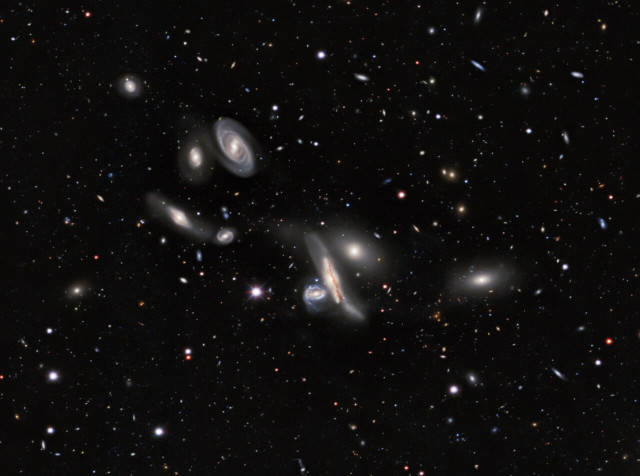
Some of the galaxies included in the DESI Legacy Imaging Surveys map (Image: DESI Legacy Imaging Surveys/LBNL/DOE & KPNO/CTIO/NOIRLab/NSF/AURA)

The DESI Legacy Imaging Surveys team has released the largest 2D map of the universe. Consisting of 5.6 trillion pixels, this map includes nearly 4 billion celestial objects, ranging from asteroids to galaxies, as well as other objects such as stars, black holes, and more. It’s a vast archive spanning approximately three-quarters of the sky, useful for astronomical studies requiring information at optical and near-infrared frequencies. This result isn’t the final one, as the map will be used to determine the distances to objects such as quasars to construct a new map, this time 3D.

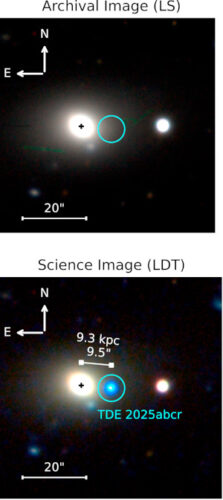
An archival image of the galaxy WISEA J014656.04-152214.7 and the location of the TDE 2025abcr event (above), as well as the same area imaged on December 14, 2025, with the tidal disruption event visible in the blue circle

An article published in “The Astrophysical Journal Letters” reports the discovery of a supermassive black hole on the outskirts of its host galaxy WISEA J014656.04-152214.7, approximately 30,000 light-years from its center. A team of researchers found its traces thanks to a so-called tidal disruption event cataloged as TDE 2025abcr. Detected for the first time by the Zwicky Transient Facility (ZTF), thanks in part to a new artificial intelligence algorithm, the event was confirmed and studied for months in various electromagnetic bands using various instruments. This discovery supports the theory that wandering supermassive black holes can exist very distant from the center of a galaxy, where they normally reside.

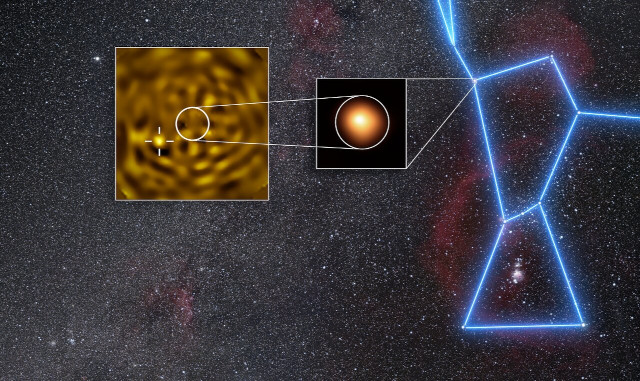
From right: Orion, Betelgeuse, and a detail of the star candidate Betelgeuse B (Image ESO/M. Montargès et al. Background: N. Rissinger (skysurvey.org))

An article published in the journal “Astronomy & Astrophysics” offers the best evidence yet for the existence of a companion to the star Betelgeuse. A team of researchers led by Miguel Montargès of the Paris Observatory – PSL used the SPHERE instrument, and specifically its ZIMPOL polarimeter, mounted on the VLT in Chile to capture a direct image of what appears to be a star close to Betelgeuse. Independent observations will be needed to confirm the existence of the candidate Betelgeuse B. This study suggests it’s a star with a mass between 2.6 and 3.1 times the Sun’s.

The Soyuz MS-27 spacecraft's capsule surrounded by the support crew (Image NASA+)

A little while ago, cosmonauts Sergey Kud‑Sverchkov and Sergei Mikaev and astronaut Chris Williams returned to Earth on the Soyuz MS-28 spacecraft, which landed in Kazakhstan. They had reached the International Space Station on November 27, 2025, as part of a normal crew rotation. The capsule landed on its side, an event that can occur due to reentry conditions, but the crew members suffered no injuries.

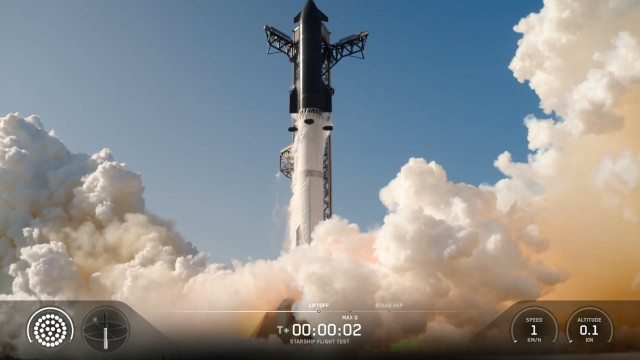
Starship 40 lifts off atop the Super Heavy 20 (Image courtesy of SpaceX)

It was the afternoon in the USA when SpaceX conducted a new flight test of its Super Heavy rocket and Starship prototypes, launched from its base in Boca Chica, Texas. This is the 13th test involving the entire system of Elon Musk’s company, which is supposed to revolutionize space travel with an unprecedented transport capacity and be totally reusable. They are advanced prototypes with the Super Heavy identified as Booster 20 and the Starship identified as Starship 40 or Ship40 or simply S40. It was the second test of the vehicles in their Block 3 version.