2026

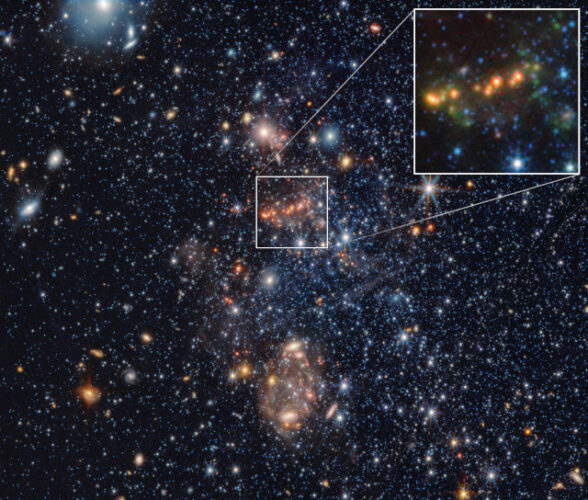
The Sextans A galaxy. In the inset, in green, polycyclic aromatic hydrocarbons (Image NASA, ESA, CSA, Elizabeth Tarantino (STScI), Martha Boyer (STScI), Julia Roman-Duval (STScI); Image Processing: Alyssa Pagan (STScI))

An article published in “The Astrophysical Journal” reports the results of a study of dust generated by red giant stars towards the end of their lives under conditions similar to those existing in the first galaxies of the universe. A team of researchers led by Claudio Gavetti of the Italian National Institute for Astrophysics and the University of Roma Tre used observations conducted with the James Webb Space Telescope to study the Sextans A dwarf galaxy, where the environment is very metal-poor. Observations of a quality unimaginable in the past allowed to understand how these stars produce cosmic dust in environments similar to those of the early universe.

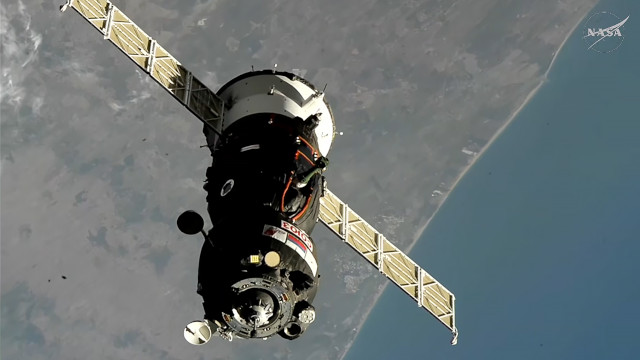
The Soyuz MS-29 spacecraft approaching the International Space Station (Image NASA+)

A few hours ago, the Soyuz MS-29 spacecraft was launched from the Baikonur Cosmodrome, Kazakhstan, and, after a little more than three hours, reached the International Space Station with three new crew members on board. It docked with the Station’s Prichal module. The ultra-fast track was used, which halves the journey duration and is used whenever the Station’s position makes it possible.

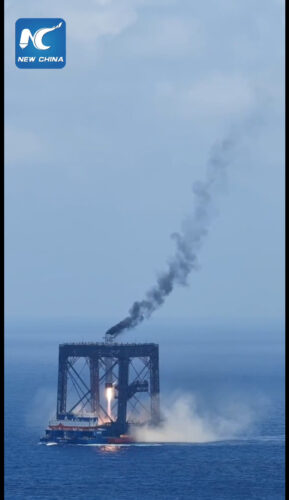
The first stage of the Long March 10B rocket during landing at the end of its maiden flight (Image courtesy of New China)

A few hours ago, the Long March 10B rocket performed its maiden flight, which started with its launch from the Wenchang launch site. The rocket’s first stage also performed a controlled landing on a sea platform, as part of the development of a reusable launch system. This is a significant achievement because it’s a rocket that will be used for China’s crewed Moon missions.

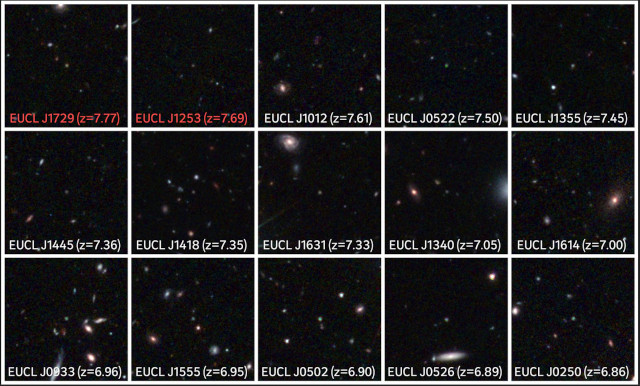
15 of the 31 discovered quasars. Each of them is visible as a dot at the center of its image. The two oldest quasars are shown in red.

An article published in the journal “Astronomy & Astrophysics” reports the discovery of 31 new primordial quasars, including the two oldest known so far. A team of researchers used observations conducted with ESA’s Euclid space telescope as part of the Euclid Wide Survey to find quasars we see as they were when the universe was no more than 800 million years old.