
2026

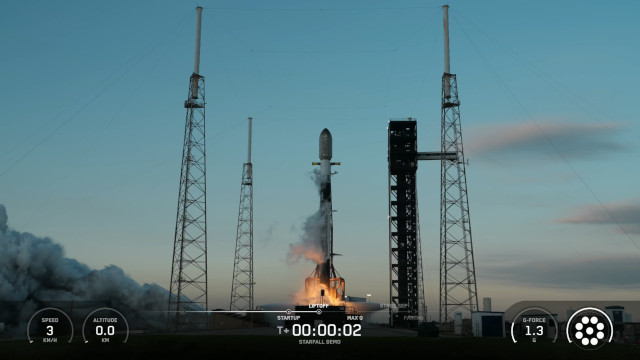
The Starfall Demo capsule blasting off atop a Falcon 9 rocket (Image courtesy SpaceX)

A little while ago, SpaceX’s Starfall Demo mission began with the launch of a capsule atop a Falcon 9 rocket from Cape Canaveral. The mission has a classified profile, meaning the launch broadcast ended after the first stage landed. Subsequently, the capsule successfully separated from the rocket’s last stage and embarked on its course, which should take it into low Earth orbit for a period that wasn’t revealed and then splash down in the Pacific Ocean. This mission aims to demonstrate the feasibility of returning cargo weighing up to 1,000 kilograms produced in orbit to Earth, or even transporting payloads very quickly to other continents.

A combination of data collected with the ALMA radio telescope, shown in red, and the Chandra X-ray Observatory, shown in blue. Sagittarius A* is at the center.

An article published in “The Astrophysical Journal Letters” reports evidence of a cosmic wind emanating from Sagittarius A*, the supermassive black hole at the center of the Milky Way. Mark D. Gorski and Lena Murchikova of Northwestern University’s Center for Interdisciplinary Exploration and Research in Astrophysics used observations with the ALMA radio telescope and NASA’s Chandra X-ray Observatory to create a high-quality map of the cold carbon monoxide gas surrounding Sagittarius A*. The map shows a cone-shaped cavity where a hot, energetic wind blows and sweeps away the gas.

Abell 2744-QS01. The insets show zooms of three separate views of QS01 generated by gravitational lensing

Two articles, one published in the journal “Nature” and one in the “Monthly Notices of the Royal Astronomical Society”, report different aspects of a study of the supermassive black hole cataloged as Abell 2744-QSO1, or simply QSO1, indicating that it’s older than its host galaxy. A team of researchers used observations with the James Webb Space Telescope to study QSO1 and measured its mass at about 50 million times the Sun’s. This means it makes up at least two-thirds of the total mass of the galaxy, an anomaly that betrays its age and leaves open some possible hypotheses about its origin.

The capsule of the Shenzhou 22 spacecraft after landing (Photo courtesy Xinhua/Lian Zhen)

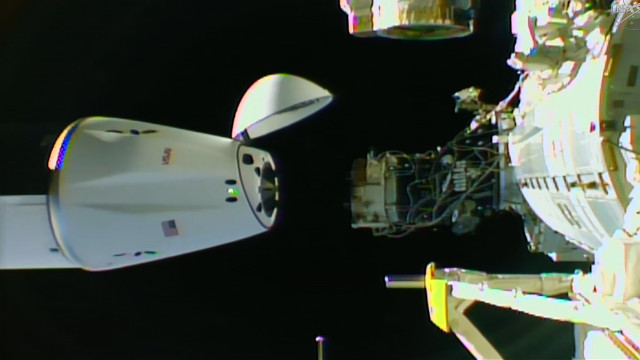
A few hours ago, the three Chinese taikonauts of the Shenzhou 22 mission returned to Earth after spending 210 days on the Tiangong space station, where they arrived on October 31, 2025, in the mission that started as Shenzhou 21. The three taikonauts, Zhang Lu, Wu Fei, and Zhang Hongzhang, had departed the station less than six hours earlier to land at a site called Dongfeng in China’s Inner Mongolia Autonomous Region.