
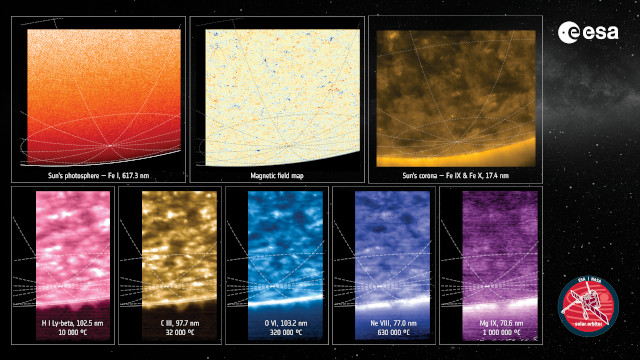
ESA has released the first information, including the first images, of the Sun’s South Pole, captured between March 16 and 17, 2025, by the Solar Orbiter space probe, a mission operated in collaboration with NASA. Three of the scientific instruments on board made it possible to observe that area in different electromagnetic bands: Polarimetric and Helioseismic Imager (PHI), Extreme Ultraviolet Imager (EUI), and Spectral Imaging of the Coronal Environment (SPICE). The Sun’s poles aren’t visible from Earth, and Solar Orbiter is observing them as never before. The first observations have already revealed some surprises.
The composite image (ESA & NASA/Solar Orbiter/PHI, EUI and SPICE Teams – CC BY-SA 3.0 IGO) from the Solar Orbiter mission showcases the Sun observed across eight different wavelengths, each revealing distinct layers and temperatures of the solar atmosphere. The top row presents the Sun’s photosphere in visible light, a magnetic field map, and the corona in extreme ultraviolet. The bottom row spans ultraviolet observations from 10000 °C to over 1.2 million °C, highlighting emissions from hydrogen, carbon, oxygen, neon, and magnesium. These multi-wavelength views help scientists understand the Sun’s complex structure and dynamic behaviour across its outer layers.
Launched on February 10, 2020, the Solar Orbiter space probe is one of the spacecraft designed to study the Sun. In February 2025, it made a flyby of the planet Venus, which was necessary, among other things, to tilt its trajectory with respect to the ecliptic. This was a step that was specifically intended to enable it to observe the Sun’s polar regions.
The combination of observations conducted with the PHI, EUI, and SPICE instruments allowed to detect various processes at work at the Sun’s South Pole. The magnetism showed chaotic characteristics that exist only for a short time, when the magnetic field flip. Solar Orbiter detected that both magnetic poles are currently located at the geographic South Pole. During the next 11-year solar cycle, the magnetic poles will slowly return to their antipodal positions and the Sun will reach the solar minimum, so called because it’s the period of minimum activity.
The reasons for this development of the solar magnetic field aren’t yet well understood. This makes the observations conducted in March by the Solar Orbiter space probe precious, precisely at the time when a new solar cycle is starting. The observations obtained across the entire Sun’s surface showed that the structure of the solar magnetic field is complex and constantly changing.
Another result obtained thanks to the SPICE instrument was the mapping at levels never seen before of the movements of various chemical elements in the various layers above the Sun’s surface. This instrument is a spectrograph capable of detecting the chemical signatures of the various elements, and in the last five years, it has carried out a remarkable mapping. The Sun is composed mainly of hydrogen with a part of helium, but it also contains traces of other elements, whose presence and movements can be traced by instruments such as SPICE.
The spectral lines of hydrogen, carbon, oxygen, neon, and magnesium made it possible to verify their temperatures and, above all, to map their movement: for the first time, it was possible to reconstruct the movement of colossal clumps of solar matter.
The detections obtained in March arrived with the Solar Orbiter space probe at an orbital inclination of 17° with respect to the ecliptic plane. It will be increased to 24° by the end of 2026 to obtain even better quality observations of the Sun’s polar areas. If the mission is extended to 2030, the plan is to increase the inclination further to 33°. In short, if these results are already excellent, we can expect more, starting with data from the first pole-to-pole flight, which should be available in October 2025.
