
An article published in the journal “Nature Astronomy” reports the results of a study on the interstellar comet 3I/ATLAS, which indicate that it formed in a much colder environment than the solar system. This conclusion was reached by a team of researchers led by Luis E. Salazar Manzano, a Ph.D. student at the University of Michigan, using observations conducted with the Atacama Large Millimeter/submillimeter Array (ALMA) radio telescope. Specifically, the Atacama Compact Array (ACA) revealed a ratio of so-called semi-heavy water to ordinary water at least 30 times higher than that found in solar system comets and over 40 times higher than that found in Earth’s oceans. Such an enrichment of water with so many deuterium atoms can only occur in very cold environments, around 30 Kelvin.
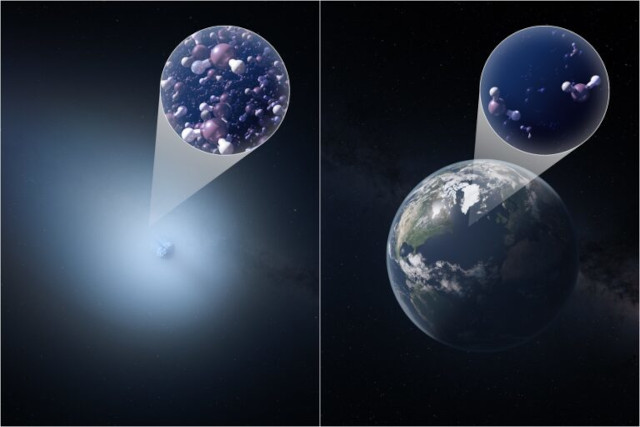
This image (NSF/AUI/NSF NRAO/M. Weiss) shows an artist’s concept comparing the semi-heavy water content of interstellar comet 3I/ATLAS to that of Earth. The insets show the relative abundance of water containing deuterium instead of normal hydrogen.
There has been considerable curiosity about the possible conditions in the star system in which interstellar comet 3I/ATLAS formed since its discovery was announced in July 2025. For this reason, any measurement of its characteristics leads to the study of similarities and differences with comets in the solar system in the hope of understanding more about its origins.
A comet’s chemical composition is determined by the conditions in which it formed. In the case of water, clues to these conditions can come from estimating how much is ordinary water and how much contains two deuterium atoms instead of normal hydrogen, or one deuterium atom and one normal hydrogen atom. These deuterium-enriched molecules are called heavy water and semi-heavy water, respectively.
In comets in the solar system, there’s on average one molecule of semi-heavy water for every 10,000 molecules of ordinary water. The detections for this study were conducted with ALMA’s ACA, an array of 16 closely spaced antennas, 7 meters and 12 meters in diameter, within ALMA, and useful for specific studies. The ACA allowed us to estimate that interstellar comet 3I/ATLAS contains quantities of semi-heavy water relative to ordinary water at least 30 times the ratio found in solar system comets and over 40 times the ratio found in Earth’s oceans.
The processes that determine the amount of deuterium present in water are strongly influenced by the temperatures at which the molecules form. It’s estimated that the water in interstellar comet 3I/ATLAS must have formed in an extremely cold environment, around 30 Kelvin.
This type of information is also interesting because the abundance of normal hydrogen and deuterium was established right at the beginning of the universe’s history, with the Big Bang. This means that information about other star systems can also help reconstruct the initial conditions in the universe’s history.
The trajectory of interstellar comet 3I/ATLAS is not favorable for studying it. It’s quickly moving away from Earth and is now beyond the orbit of Jupiter, making any observation attempts increasingly difficult. Despite this, astronomers are attempting every type of observation to obtain every possible information from an object originating from who knows how many light-years away.
