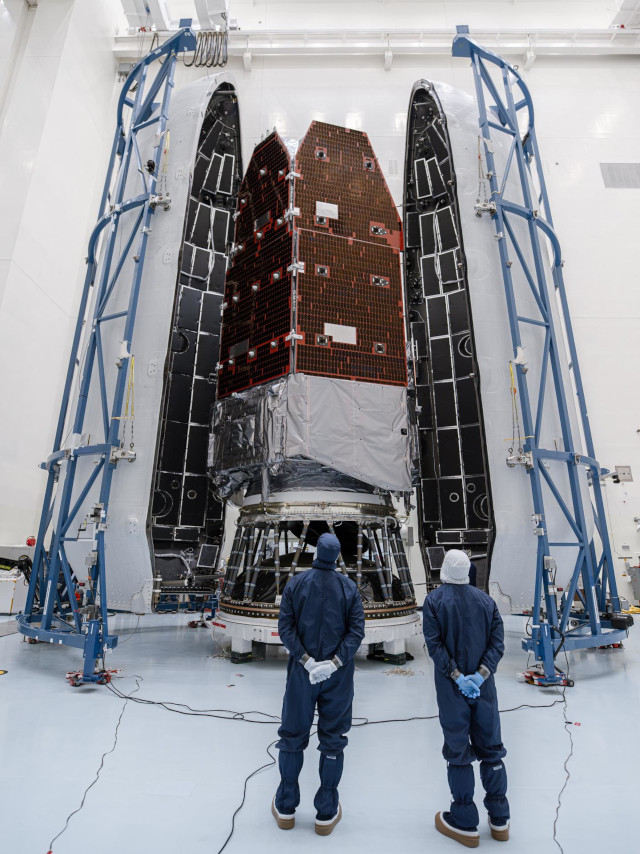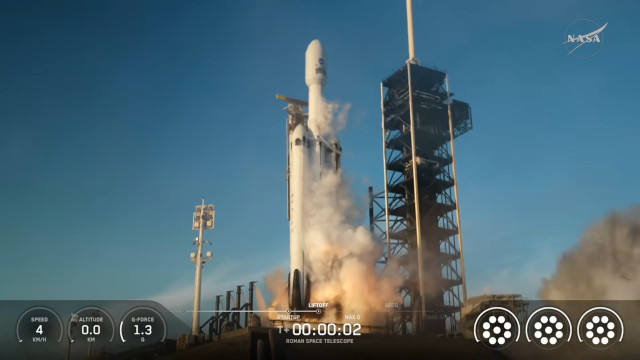
A little while ago, NASA’s Nancy Grace Roman Space Telescope was launched atop a SpaceX Falcon Heavy rocket from the Kennedy Space Center. After just over 31 minutes, it successfully separated from the rocket’s last stage and set course for the area known as L2 (Lagrange Point 2), where its scientific mission will begin.
Originally known as the Wide Field InfraRed Survey Telescope (WFIRST) and later named after astronomer Nancy Grace Roman, this space telescope had a complicated and unusual history. Various infrared astronomy projects seemed impossible to approve due to a lack of funding, but in 2012, the National Reconnaissance Office (NRO) donated two unused spy satellites to NASA, each equipped with a mirror the size of Hubble’s, which has a diameter of 2.4 meters. This allowed this project to get started.
The availability of a sort of home base with a telescope absorbed a significant portion of the development costs. Despite this, the project was saved from cancellation in 2018 only thanks to a U.S. congressional appropriation. Contributions from other space agencies and organizations such as ESA and JAXA helped its development.
About ten years after its approval, the Nancy Grace Roman Space Telescope has finally been launched, but this is only the beginning of a long journey that will take it to the area where other space telescopes already work. In the area called L2, it will operate in a very stable environment, requiring minimal use of available fuel.
Nancy Grace Roman is considered the mother of the Hubble Space Telescope due to the importance she played in planning the space astronomy project that led to its construction. The space telescope named after her is considered in some ways the successor to Hubble, but its purposes are somewhat different, more similar to those of ESA’s Euclid Space Telescope.
Cosmological studies connected to dark matter and dark energy will benefit from the capabilities of the Nancy Grace Roman Space Telescope. Other astronomical research, such as that about exoplanets, will also be able to make progress. It will gather an amount of information far greater than Hubble thanks to its field of view. It will be complemented by other major astronomical programs.
If everything goes well, it will take some months for it to reach the L2 area and conduct all the necessary tests to ensure that it’s working properly, and then astronomers expect to begin obtaining important scientific results. Its primary mission is expected to last five years. It’s currently impossible to refuel, but it was designed for a possible future refuelling mission.