
An article published in the journal “Science” reports the first measurement of the winds blowing in the atmosphere of the brown dwarf cataloged as 2MASS J10475385+2124234. A team of researchers led by Katelyn Allers of Bucknell University combined observations conducted with the Very Large Array (VLA) and NASA’s Spitzer space telescope to achieve this result. The method was already used for planets like Jupiter, so the news is its extension to a brown dwarf, and could also concern gaseous exoplanets.
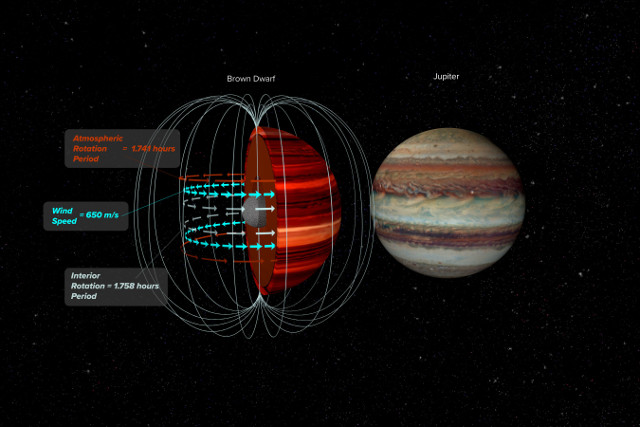
About 34 light-years from Earth, the brown dwarf 2MASS J10475385+2124234 has a size similar to Jupiter’s, but is about 40 many more massive. These objects are considered failed stars because their mass is not enough to trigger the thermonuclear reactions that make stars so bright. The image (Bill Saxton, NRAO/AUI/NSF) shows an illustration of a brown dwarf near Jupiter and the brown dwarf’s magnetic field together with the different emissions detected.
On a planet like Earth, the term wind indicates the motion of air relative to the solid or liquid planet surface. On a gaseous planet or a brown dwarf, composed almost entirely of gas, the term has a somewhat different meaning. In the upper layers of a brown dwarf, portions of gas can move independently. At certain depths, the pressure becomes so intense that the gas moves all together, as if it were a solid sphere, dragging the upper layers. However, speed differences between the various layers remain and they’re measurable.
In Jupiter’s case, the rotation period measured by observing its radio emissions is different from the one measured by observing its visible and infrared light emissions. That’s due to the different origins of those two types of emissions. Radio waves are generated by electrons that interact with Jupiter’s magnetic field, which originated in its depths. Infrareds come instead from the upper layers of Jupiter’s atmosphere, which rotates faster than the deeper layers. The difference between the two speeds is that of the atmospheric winds.
Katelyn Allers’s team tried to apply the same measurement method to the brown dwarf 2MASS J10475385+2124234 expecting that mechanisms similar to those of gaseous planets are in place. In 2017 and 2018, the researchers used the Spitzer space telescope to detect infrared emissions from this object and discovered regular variations they attributed to the rotation of some long-lasting structure in its atmosphere’s upper layers. Subsequently, they detected radio emissions using the VLA and measured the deeper layers’ rotational speed.
The results confirmed the similarities with gaseous planets since in 2MASS J10475385+2124234 the atmosphere also rotates faster than the inner layers, with a wind calculated at over 650 meters per second. The winds on Jupiter are very fast, around 100 meters per second, but it’s a speed much lower than that found in the brown dwarf under examination’s atmosphere. This difference isn’t a surprise because it was predicted by the theoretical models on brown dwarfs, which consequently received a confirmation.
This method, already used for years for the solar system’s planets, also proved valid for brown dwarfs and the researchers intend to further extend it to gaseous exoplanets. In this regard, Peter Williams of the Center for Astrophysics, Harvard & Smithsonian, and the American Astronomical Society explained that the giant exoplanets’ magnetic fields are weaker than brown dwarfs’ so radio measurements should be made at frequencies lower than those used for 2MASS J10475385+2124234.
Katelyn Allers added that she and her colleagues are excited because with this method they can learn how the chemistry, atmospheric dynamics, and the environment around an object are interconnected offering a truly complete view of the exoplanets studied. In short, this type of study could offer progress in our knowledge of gaseous exoplanets.
