An article published in the journal “Astronomy & Astrophysics” reports the first case of high-resolution infrared observations of the internal areas of 15 protoplanetary disks performed by combining the four telescopes of the ESO VLT interferometer in Chile. A team of researchers led by Jacques Kluska of the Katholieke Universiteit Leuven in Belgium used the PIONIER instrument to achieve this result, which also shows traces of planetary formation. This type of observation offers new information on this process.
Images of very young stars or even protostars surrounded by protoplanetary disks are nothing new. Radio telescopes such as ALMA have often been used to study planetary formation processes because they detect emissions at wavelengths that pass through the gas and dust that form those disks. In other cases, telescopes that detect infrareds have been used since those wavelengths can be detected as well, but are unable to obtain details, especially of the internal areas, where rocky planets like Earth are formed.
In order to obtain details of the area of planetary disks within a distance from their protostar lower than that of the Earth from the Sun, Jacques Kluska’s team applied the technique of interferometry, in this case infrared, to the telescopes of the VLT (Very Large Telescope). In essence, the PIONIER (Precision Integrated-Optics Near-infrared Imaging ExpeRiment) instrument enables to combine the observations of the four VLT telescopes. This technique was applied to 15 planetary systems in formation around Herbig Ae/Be stars, a class of stars less than 10 million years old that are still completing their formation.
By its nature, this technique doesn’t directly show the details of the observed objects, but they need to proceed to a further step. A mathematical reconstruction technique called SPARCO (Semi Parametric Approach for image Reconstruction of Chromatic Objects), described in an article also published in “Astronomy & Astrophysics” in April 2014 by a team also led by Jacques Kluska allows to remove the stars and to bring out the details of the internal area of the protoplanetary disks.
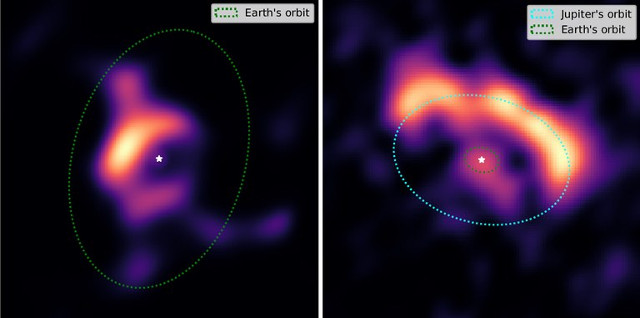
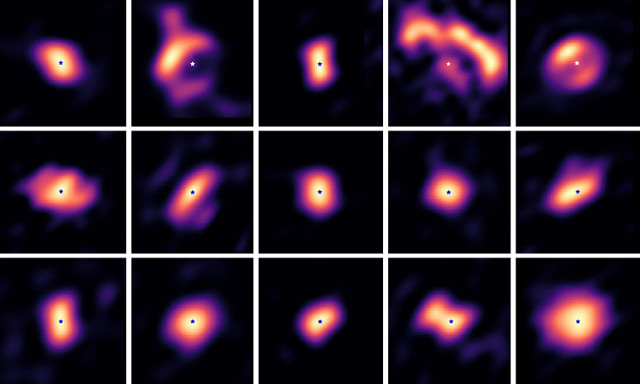
The top image (Courtesy Jacques Kluska et al. All rights reserved) shows the 15 protoplanetary disks photographed using the PIONIER instrument. The bottom image (Courtesy Jacques Kluska et al. All rights reserved) shows, in particular, the protoplanetary disks around the stars R CrA (left) with an indication of the Earth’s orbit and HD45677 (right) with the indication of Jupiter and the Earth’s orbits.
The images obtained show different brightness in different areas and these irregularities suggest that planetary formation processes are in progress. This is only the first phase of the research, which will continue to analyze those irregularities to ascertain their causes. Understanding where planets are actually forming and where other chaotic processes may be taking place will be helpful to improve current planetary formation models. Jacques Kluska’s team also started studying 11 disks around older stars in which planets could be forming.
This type of research that exploits emissions in near infrareds offers a new point of view in the study of protoplanetary disks. Combining the data with other studies on planetary systems in formation will offer more complete information with different images of various stages of that process.