An article published in “The Astrophysical Journal” offers an explanation of the origin of the so-called Fermi bubbles, the two gigantic gas bubbles existing above and below the center of the Milky Way. Guo Fulai and Zhang Ruiyu of the Shanghai Astronomical Observatory (SHAO) of the Chinese Academy of Sciences conducted a series of simulations that allowed to create a model that explains the origin of the Fermi bubbles and at the same time of the biconical X-ray structure at the center of the galaxy. According to the new model, the two phenomena are caused by shock waves generated by two jets from Sagittarius A*, or simply Sgr A*, the supermassive black hole at the center of the Milky Way, around 5 million years ago.
Fermi bubbles were discovered in 2010 using NASA’s Fermi gamma-ray space telescope by observing the center of the Milky Way. They extend above and below the supermassive black hole that occupies that area for about 25,000 light-years. In the following years they have been studied several times with various instruments using their connection with Sgr A* as a starting point to try to find out their origin, but so far without success. Now the answer proposed by two Chinese researchers could be the solution to the mystery.
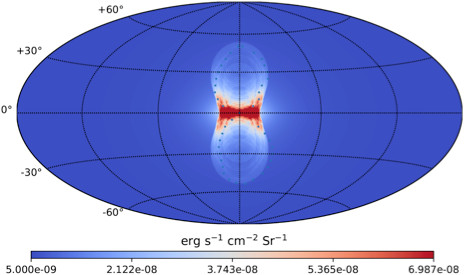
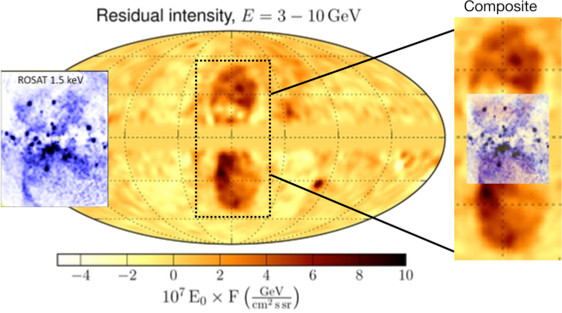
The observations of Fermi bubbles show that they’re very bright in gamma rays, where they have very sharp edges which coincide well with the biconical structure visible in X-rays. The top image (Courtesy Bland-Hawthorn, J. et al. All rights reserved) shows observations of the center of the Milky Way conducted at gamma rays by NASA’s Fermi space telescope and at X-rays by NASA and DLR’s ROSAT space telescope. The superimposition of the observations shows how Fermi bubbles coincide with the biconical structure. The bottom image (Courtesy Zhang and Guo. All rights reserved) shows a simulated X-ray brightness map in the new model. The dotted line delimits the Fermi bubbles observed at gamma rays.
Because of that coincidence, Guo Fulai and Zhang Ruiyu realized that those structures could have the same origin, solving the problem of previous computer models and simulations, which tried to offer different explanations for those two phenomena. The biconical X-ray structure could be explained naturally by the shocked thin shell of the hot gas that was generated by an outburst that occurred in the past in the center of the Milky Way.
Today Sgr A* is quiet, but according to the new model in the past it may have behaved as an active galactic nucleus. According to the simulations, the energy produced by the event that generated the Fermi bubbles and the biconical structure was like about 20,000 supernovae consuming an amount of materials equal to about 100 times the mass of the Sun. About 5 million years ago, the supermassive black hole may have swallowed up a large amount of materials, perhaps an interstellar cloud that ended up in its gravitational field, starting an activity that lasted about a million years, also marked by the two phenomena.
After the discovery of Fermi bubbles at the center of the Milky Way, astronomers started searching for traces of them in other galaxies as well. These searches could help verify the explanation for their origin offered by Guo Fulai and Zhang Ruiyu together with further studies of the ones in the Milky Way.