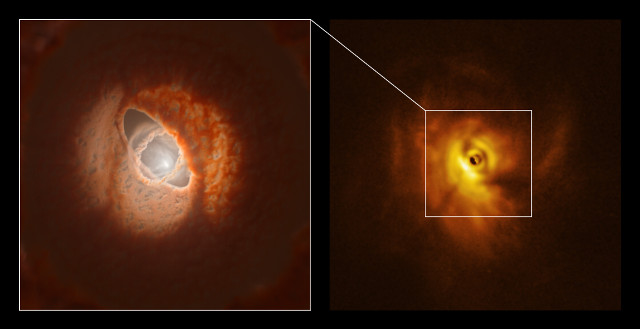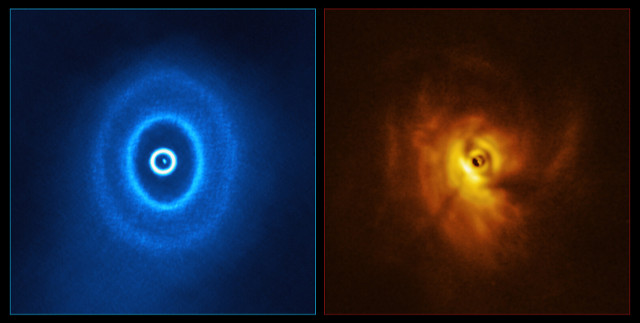
An article published in the journal “Science” reports a research on the characteristics of the circumstellar disk of the GW Orionis system, or GW Ori, warped by the action of the three stars that form it. A team of researchers used the AMBER and later GRAVITY and SPHERE instruments mounted on ESO’s VLTI and the ALMA radio telescope to observe the disk’s twisted shapes and the three rings into which it’s divided, which are misaligned. The innermost ring is made up of an amount of materials estimated to be about 30 times the Earth’s mass, so planets could form. The goal of the studies of this triple system is to understand if planets with stable orbits can form in its rings, a step forward to understand this type of processes in double or multiple systems.
Just over 1,300 light-years from Earth, the GW Ori system has been known for a long time, but its characteristics were discovered slowly, and only in 2011 the discovery of a third star was announced. This system’s three very young stars are gravitationally bound with GW Ori A and GW Ori B separated by a distance close to that between the Earth and the Sun and GW Ori C which orbits its two companions at a distance from them that is about 8 times that between the Earth and the Sun.
GW Ori’s circumstellar disk turned out to be very interesting due to the influence of the three stars, which tore it apart forming three concentric rings. This new study is the result of a work started in 2008 and conducted using various instruments mounted on the VLTI (Very Large Telescope Interferometer) and with the ALMA radio telescope to cover different wavelengths. The AMBER (Astronomical Multi-BEam combineR) instrument was the first of the VLTI used, but in recent years GRAVITY and SPHERE (Spectro-Polarimetric High-contrast Exoplanet REsearch instrument) were installed, which allowed to further improve the quality of the observations.
The combined observations conducted over the years of GW Ori’s system allowed to see the misalignment of the rings that form the disk up to the point of seeing the shadow that the innermost ring casts on the rest of the disk. All this was useful in reconstructing the 3D structure of this disk torn by the influences of the three stars.
Jiaqing Bi of the University of Victoria, Canada, part of the team that conducted observations of GW Ori’s system with the ALMA radio telescope with results reported in an article published in “The Astrophysical Journal Letters” in May 2020, stated that he and his colleagues think that the presence of a planet between the three rings that make up the circumstellar disk is needed to explain why the disk tore apart.
In this new study, computer simulations accompanied the observations to try to create a model of GW Ori’s system. The result is a link between the misalignment and the theoretical tearing effect of the disk. This suggests that the stars attracting the disk in different planes can cause warping and tearing.
The confirmation of the study published a few months ago is positive, and the combination of various instruments offered further details. The VLTI’s SPHERE instrument, activated in June 2014, is mainly used in research on exoplanets but can be useful in other cases as well such as the study of systems in formation such as GW Ori. It’s not yet clear if there are planets in formation, and observations will continue to try to understand this.