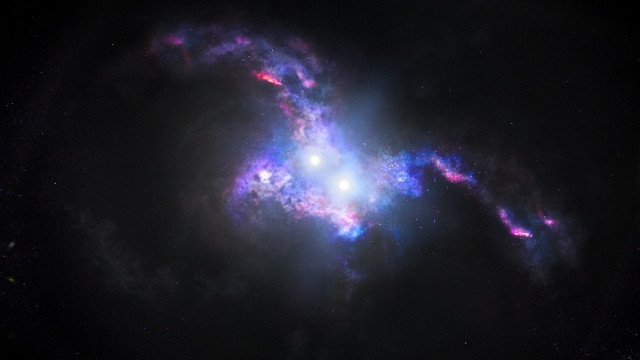
An article (link to the file in PDF format) published in the journal “Nature Astronomy” reports the discovery of two double quasars that could be part of a hidden population because two quasars that are very close are difficult to distinguish. A team of researchers used Hubble Space Telescope observations of quasars to find these pairs dating back to about 10 billion years ago. The two quasars of each pair are about 10,000 light-years apart, and the galaxies that host them will merge and at a certain point the supermassive black holes that power the quasars will merge as well.
When the universe was younger, quasars were more common because the galaxies that host them contained more gas and dust that surrounded the supermassive black holes at their center. About 10 billion years ago there was a peak in the number of quasars, and there were also many cases of galaxy mergers at that time. This means that there must have been many cases of double quasars as well.
According to Yue Shen of the University of Illinois at Urbana-Champaign, lead author of this research, in the distant universe, there’s a double quasar for every thousand quasars. This means that finding a double quasar is like finding a needle in a haystack. His team started with a census of quasars in the early universe created using observations conducted with the Hubble Space Telescope, ESA’s Gaia space probe, the Sloan Digital Sky Survey, and a series of ground-based telescopes.
In the images obtained using ground-based telescopes, the double quasars are so close to each other that they appear as a single object. Not even Gaia can distinguish them but manages to detect some anomalies in their position which makes them interesting candidates. It took observations conducted with the Hubble Space Telescope to distinguish the two quasars of a pair. Ground-based telescopes were still useful for follow-up observations because the Gemini Multi-Object Spectrograph (GMOS) instrument on the Gemini North telescope in Hawaii can distinguish the spectrometric emissions of the two quasars. These observations are also important to avoid stumbling into the image of a single quasar split by a gravitational lens. In this case, the researchers found no galaxies between the observed quasars and the Earth that could bend the quasars’ emissions.
The top image (NASA, ESA, H. Hwang and N. Zakamska (Johns Hopkins University), and Y. Shen (University of Illinois, Urbana-Champaign)) shows the quasar pairs cataloged as J0749+2255 and J0841+4825 seen by the Hubble Space Telescope’s Wide Field Camera 3 WFC3) instrument in visible light. We see these pairs as they were about 10 billion years ago, quasars at the center of galaxies about 10,000 light-years away from each other. This means that from our point of view they are in the early stages of a merger that we will see continuing for many millions of years.
The influence of supermassive black holes on their host galaxies has been an important topic of astronomical research in recent years. In the presence of active galactic nuclei such as quasars, the influence can be truly remarkable given that they move enormous amounts of materials and generate very strong electromagnetic emissions. When they have consumed all the materials that produce quasar activity, their activity ceases and the host galaxies evolve into normal elliptical galaxies.
Many quasar pairs were already known but those discovered in this research are the farthest and therefore the oldest. The researchers believe they can discover more double quasars with the same method in order to investigate in-depth the evolution of very ancient galaxies and their supermassive black holes.