
An article published in the journal “Monthly Notices of the Royal Astronomical Society” reports a study on the type Ib supernova cataloged as 2019yvr and on its progenitor star, which is enveloped by hydrogen layers that are unexpected in that type of supernova. A team of researchers led by Charles Kilpatrick, a postdoctoral fellow at Northwestern University, used observations made with the Hubble Space Telescope about 2.6 years before the supernova to examine the progenitor star, a yellow supergiant with characteristics very different from those they generally generate a type Ib supernova. One possibility regarding the hydrogen missing in the supernova is that it was snatched from this star by a companion.
The supernova 2019yvr was identified in the galaxy NGC 4666, about 55 million light-years from Earth, on December 27, 2019, by the telescopes of the ATLAS (Asteroid Terrestrial impact Last Alert System) program. The spread of the news led to follow-up observations with other telescopes that made it possible to examine its light and spectroscopic curves and therefore to establish that it was a type Ib supernova. That’s an explosion generated by the death of a star with a mass at least nine times greater than the Sun’s that ejects materials devoid of hydrogen.
Part of the study of a supernova is the search for its progenitor star, whose characteristics and changes before the explosion can provide new insights into the processes preceding its violent death. For this reason, astronomers conduct this type of research in the observation archives of various telescopes. In this case, Charles Kilpatrick’s team found the star in archival images of the galaxy NGC 4666 captured using the Hubble Space Telescope.
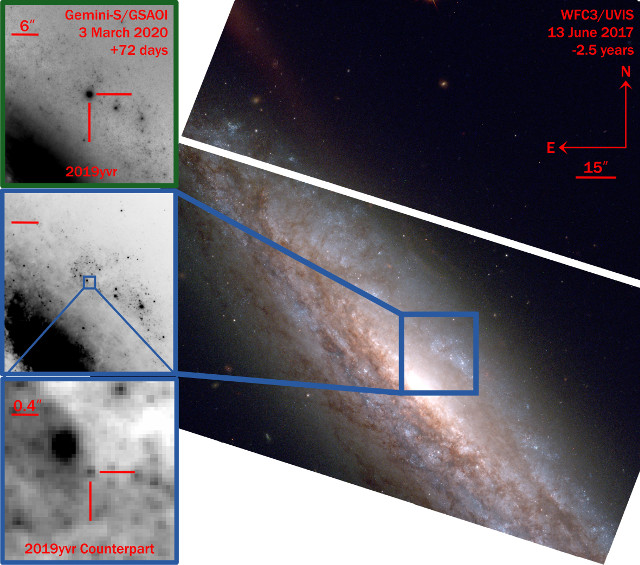
The image above (HST/Gemini) shows the supernova 2019yvr and the probable progenitor star. Top left, the supernova seen by the Gemini South telescope 72 days after the explosion. In the other two insets on the left, images of the Hubble Space Telescope at different magnifications captured 2.6 years before the explosion. Right, the galaxy NGC 4666 as seen from the Hubble Space Telescope.
The probable progenitor star is a yellow supergiant with a mass about 30 times the Sun’s. Its surface temperature is relatively low at 6,500° Celsius, close to the Sun’s, a situation that indicates the presence of a huge hydrogen envelope. However, the analysis of the supernova data shows no trace of that envelope. This star was a surprise because it was very different from what astronomers expected, which was a less massive star with no hydrogen in its outer layers.
Charles Kilpatrick’s team tried to analyze the information collected, including that about observations of the evolution of the supernova 2019yvr in the period following the explosion. The data indicates that the materials ejected from the supernova collided with a huge mass of hydrogen. It’s possible that the progenitor star ejected those layers long before exploding or they were snatched from the star by a less massive companion. The supernova is still very bright, so it will be impossible to look for a possible companion for a few more years. In essence, it’s a research on a strange supernova that will continue for several more years.
