
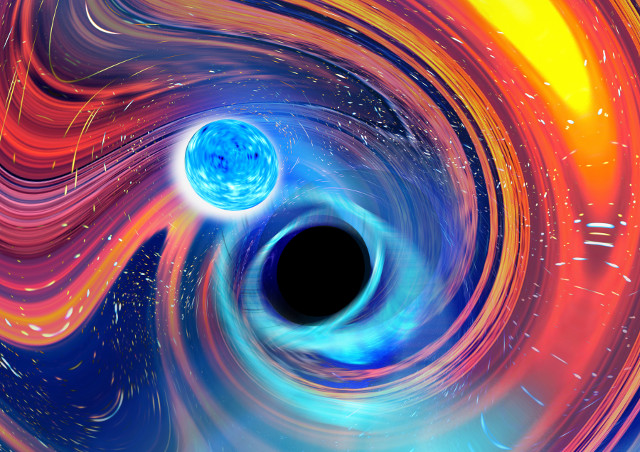
An article published in “The Astrophysical Journal Letters” reports the detection of gravitational waves emitted by two cases of mergers of a black hole with a neutron star. Scientists from the LIGO, Virgo, and KAGRA collaborations examined data collected by the Advanced LIGO and Advanced Virgo detectors to find evidence of this type of merger in two events detected in January 2020. Previously, there were other candidates but the data left various doubts about the nature of the objects that merged.
Binary systems composed of two neutron stars have been known for some decades and gravitational wave detectors have now detected many mergers of black hole pairs thanks to the mergers discovered in recent years after the announcement of the first detection in February 2016. The LIGO and Virgo detectors got upgraded and the KAGRA (Kamioka Gravitational Wave Detector) detector was activated in Japan on February 25, 2020, to obtain better detections. At the beginning of 2020, two events seem to concern the kind of “mixed” couple that was still missing: a merger between a black hole and a neutron star.
On January 5, 2020, the event cataloged as GW200105 involved a black hole with a mass approximately 8.9 times the Sun’s and a neutron star with a mass approximately 1.9 times the Sun’s. The distance of the two objects was about 900 million light-years from Earth. This event generated a particularly strong signal in the LIGO Livingston detector, the only one of the two LIGO detectors active at the time.
Only 10 days after this event, on January 15, 2020, another similar event was detected, cataloged as GW200115. It involved a black hole with a mass about 6 times the Sun’s and a neutron star with a mass about 1.5 times the Sun’s. The distance of the two objects was about a billion light-years. In this case, both LIGO detectors were active.
In both cases, the gravitational wave detection triggered an alarm for the astronomical community to try to detect electromagnetic emissions from those mergers. Their distance was considerable and the type of event, which was probably a neutron star being swallowed by a black hole rather than a merger, didn’t generate much light. In this sense, these events are very different from the kilonova, the merger of two neutron stars at the center of one of the greatest scientific collaborations in history, announced in October 2017.
In 2019, the GW190814 and GW190426 events were considered candidates for this type of “mixed” merger but the margins of error in the estimate of the masses of the objects involved left doubts about the nature of the less massive of the two. In the two events of 2020, the mass of the less massive objects leaves no doubt.
The analysis of the detected gravitational waves offers further possibilities to study extreme situations in which to test models about the fundamental laws of physics. The statistics that will gradually be obtained thanks to all the mergers detected will help to test the models connected to stellar evolution and the interactions that occur in clusters. In short, this branch of astronomy continues to grow thanks to the improvement of the detectors, so we can expect more news in the coming years.
