 Four articles – available here, here, here, and here – published in the journal “Astronomy & Astrophysics” report various aspects of the mapping of the northern galactic plane, which led, among other things, to the discovery of new areas of star formation in the Milky Way. Many researchers collaborated in the analysis of data collected within the GLOSTAR survey, which aims to examine star-forming regions within the galaxy using observations from the VLA and Effelsberg radio telescopes. The data made it possible to obtain the most detailed maps of the northern galactic plane at radio frequencies, which made it possible to identify the new star nurseries.
Two very powerful radio telescopes were used in the GLOSTAR survey: the VLA (Very Large Array), formed by an array of 27 antennas in New Mexico, USA, and the Effelsberg, which between 1972 and 2000 was the largest world steerable radio telescope with the 100-meter diameter of its single antenna in Germany. The combination of their characteristics in the GLOSTAR (Global view of the Star formation in the Milky Way) survey made it possible to obtain high-quality maps that will be used for many years also thanks to the fact that radio emissions pass through interstellar dust clouds, which block the optical frequencies.
The four articles published in “Astronomy & Astrophysics” report some initial results of the GLOSTAR survey that are very interesting and will have further development as the observations continue, like the analysis of the collected data. Star formation is one of the fields that continue to be of great interest to astronomers, so finding new star nurseries is always a great discovery.
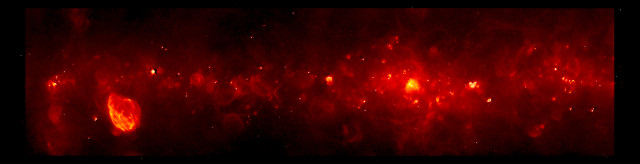
In this case, traces of the first phases of the formation of massive stars were found, including regions of hydrogen ionized by the powerful emissions of young stars and radio emissions from methanol molecules useful to identify those stars, which are still enveloped by clouds of gas and dust in which they formed and in some cases are still forming. The top image (Brunthaler et al., Sophia Dagnello, NRAO/AUI/NSF.) shows a map obtained from the GLOSTAR survey with a segment of the Milky Way disk.
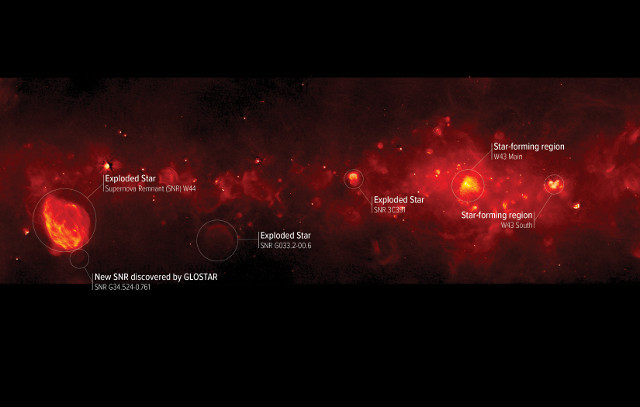
The other end of the life of the stars is also interesting from an astronomical point of view. In this case, traces of supernova remnants were found that more than doubled those discovered using the VLA alone. The models predict more than three times the number of supernova remnants known prior to the GLOSTAR survey, and this finding suggests that there are still more hidden, so the models may be correct. The bottom image (Brunthaler et al., Sophia Dagnello, NRAO/AUI/NSF.) shows a segment of the Milky Way with labels indicating both stellar nurseries and supernova remnants.
The GLOSTAR survey will probably produce some tens of thousands of images that could contain traces of an enormous amount of sources of various types that will need to be identified and verified. That’s a lot of work that will be useful for many other studies over the next decades.