
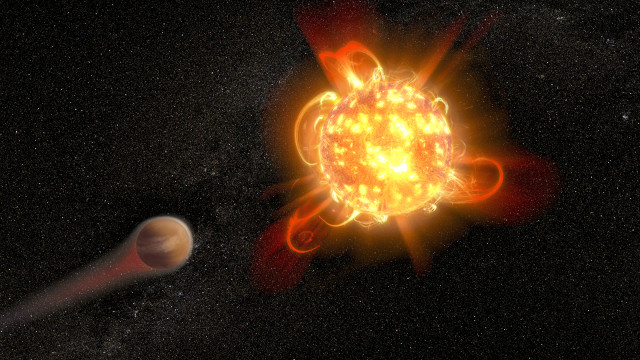
An article accepted for publication in “The Astrophysical Journal” reports the results of spectroscopic observations of the activity of the star TRAPPIST-1 conducted with the James Webb Space Telescope. A team of researchers observed four flares of this ultra-cool dwarf, which occurred over the course of about 27 hours. By adding data obtained with other instruments, it was possible to develop a mathematical method to separate the light of those flares from normal stellar radiation. In the study of a very small but also active star, this is very useful to improve the quality of observations of the seven rocky planets of the TRAPPIST-1 system.
The smallest stars are often the most active, with flares that can be frequent and intense. This decreases the chances that their planets will retain their atmosphere and the conditions in which life can emerge there. The energy released in these flares increases the difficulty in obtaining good observations of those planets and in detecting the atmospheres of those that have a magnetic field capable of protecting them.
The TRAPPIST-1 system isn’t the only one with various planets discovered around a small star, but the announcement of the identification of seven rocky planets made it particularly interesting. It was taken for granted that this system would be observed with the James Webb Space Telescope but the quality of its observations may be reduced by “contamination” caused by flares. This is not a new problem but may be more serious for a more sensitive instrument that is supposed to offer quality detections of the possible atmospheres of exoplanets orbiting red dwarfs.
Ward Howard of the University of Colorado Boulder, the lead author of this study of TRAPPIST-1 flares, compared observing a planet around a red dwarf to taking a photo of a friend at a nightclub with pulsing lights. For this reason, he and his colleagues developed a mathematical method to try to separate the light from flares from normal stellar emissions. This is a filter comparable to the ones that eliminate glare in photos taken with smartphones.
The James Webb Space Telescope’s Near Infrared Imager and Slitless Spectrograph (NIRISS) and Near Infrared Spectrograph (NIRSpec) instruments provided detections of four TRAPPIST-1 flares over about 27 hours. More data was obtained over the past few years with other instruments and was useful in the development of this sort of filter to at least reduce the presence of flare emissions.
The researchers warn that the algorithm they developed isn’t perfect but already constitutes an improvement for the analysis of the collected data by significantly increasing the precision in examining the atmosphere of an exoplanet orbiting an active red dwarf. The TRAPPIST-1 system is the most interesting with its seven rocky planets but the study also mentions the three planets of the L 98-59 system and the two planets of the LTT 1445A system. The new technique may have room for improvement and help to better understand what conditions may exist on exoplanets often struck by flares that sometimes are much more powerful than solar ones.
