Massimo Luciani

Remains of glaciers that sculpted the territory of Deuteronilus Mensae on Mars

ESA has published new images of the region of the planet Mars called Deuteronilus Mensae captured by its Mars Express space probe’s High Resolution Stereo Camera (HRSC) instrument that show a territory sculpted by the movements of glaciers that created formations such as those known as mesas. That’s a particularly interesting region because already in the last decade traces of ice still there were discovered. In the past, there was perhaps a regional ice cap in that area of ​​which Deuteronilus Mensae represents the remains.

The report of Jupiter's Great Red Spot demise might be greatly exaggerated

At the 72nd Annual Meeting of the APS Division of Fluid Dynamics, held in recent days in Seattle, Philip Marcus of the University of California, Berkeley, presented a study on Jupiter’s Great Red Spot. According to recent research, it’s shrinking but according to this new study based on photos and computer simulations that’s actually an impression due to clouds covering a part of it.

Interstellar comet 2I/Borisov seen from the Keck Observatory

A new photo of interstellar comet 2I/Borisov taken using a spectrometer at the Keck Observatory in Hawaii is now the best obtained so far and can offer new information on this object that is going through the solar system. Astronomers Pieter van Dokkum, Cheng-Han Hsieh, Shany Danieli and Gregory Laughlin of Yale University captured this image on November 24 and it includes the comet’s tail, shown in its length of nearly 160,000 kilometers in a composition that puts together 2I/Borisov and the Earth.

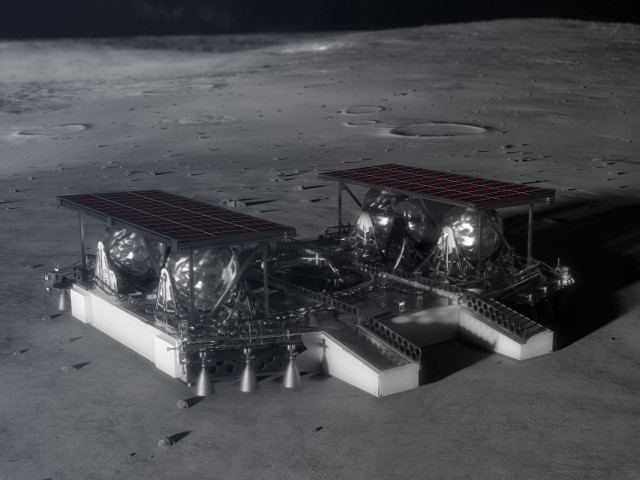
Artist's concept of lander on the Moon's surface (Image NASA)

NASA presented a medium-sized lunar lander concept that could be used during missions in the next few years within the Artemis program. The aim is to bring human beings back to the Moon, but manned missions involve a series of scientific studies with the aim of creating a stable base. Various scientific instruments and rovers will be needed that can make explorations on the lunar surface, payloads that can be brought to the surface by a lander of a type compared to a pallet. A technical publication of the concept offers references for the industries that collaborate with NASA.

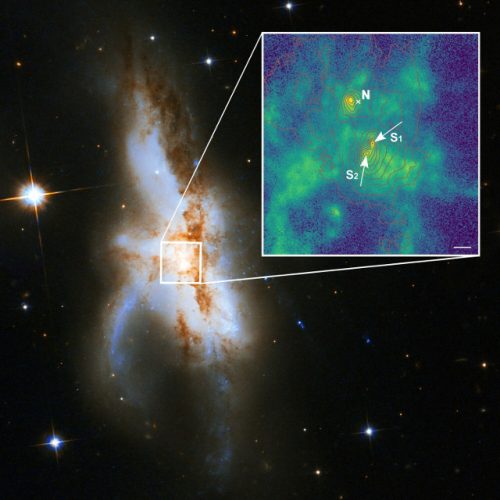
The galaxy NGC 6240 contains three supermassive black holes

An article published in the journal “Astronomy & Astrophysics” reports a study on the galaxy NGC 6240 with evidence that it contains three supermassive black holes. A team of researchers led by Professor Wolfram Kollatschny of the University of Göttingen used the MUSE instrument mounted on ESO’s VLT in Chile together with data from previous studies to obtain the high-precision observations needed to verify that within NGC 6240 there were not two supermassive black holes as it seemed from previous studies but three. This indicates that the current merger is involving three galaxies.